
If you have Direct Subsidized or Direct Unsubsidized Loans, you have a six-month grace period before your first payment is due after you graduate, leave school, or drop below half-time enrollment.
For most federal student loans, the answer to “when do payments begin?” is six months after you stop attending school at least half-time. Grad PLUS and Parent PLUS loans technically have no grace period, but Grad PLUS loans are automatically deferred for six months after you leave school, and Parent PLUS borrowers can request the same. Private loans follow whatever schedule your lender has written into the contract.
Interest will continue to accrue during that quiet stretch on nearly every loan type except subsidized loans. While the grace period pauses your required monthly payment, it does not always pause the cost of borrowing.
By the end of this article, you’ll know which clock applies to each of your loans, how much your balance might grow before repayment, and the handful of tasks worth finishing before that first payment due date arrives.
What is a Student Loan Grace Period?
A student loan grace period is the stretch of time between when you stop attending school at least half-time and when your first monthly payment is required. Federal Student Aid describes it as a window designed to help you adjust to life after college and organize your finances before repayment begins.
For most federal loans, the grace period starts the day after you graduate, withdraw, or drop below half-time enrollment.
A few things are worth being precise about:
- A grace period delays payments, not interest: On unsubsidized loans, PLUS loans, and most private loans, interest accrues daily during the grace period.
- It happens once per loan: Once you enter repayment, that loan does not get a second chance if you later need a break. You would need to use a deferment or forbearance instead.
- Not every loan has one: Grad PLUS and Parent PLUS loans don't have a grace period. Grad PLUS loans are automatically deferred for six months after you leave school, which works much the same way. Parent PLUS borrowers have to request that deferment.
- It does not mean the loan is inactive. Your servicer is still tracking the balance, and your repayment period begins the moment the grace period ends.
Sometimes a grace period is confused with a deferment. Here’s the difference:
- Grace periods are automatic and tied to leaving school.
- Deferments are applied for, usually to help with hardship, unemployment, military service, or returning to school.
When Does Repayment Start After Leaving School?
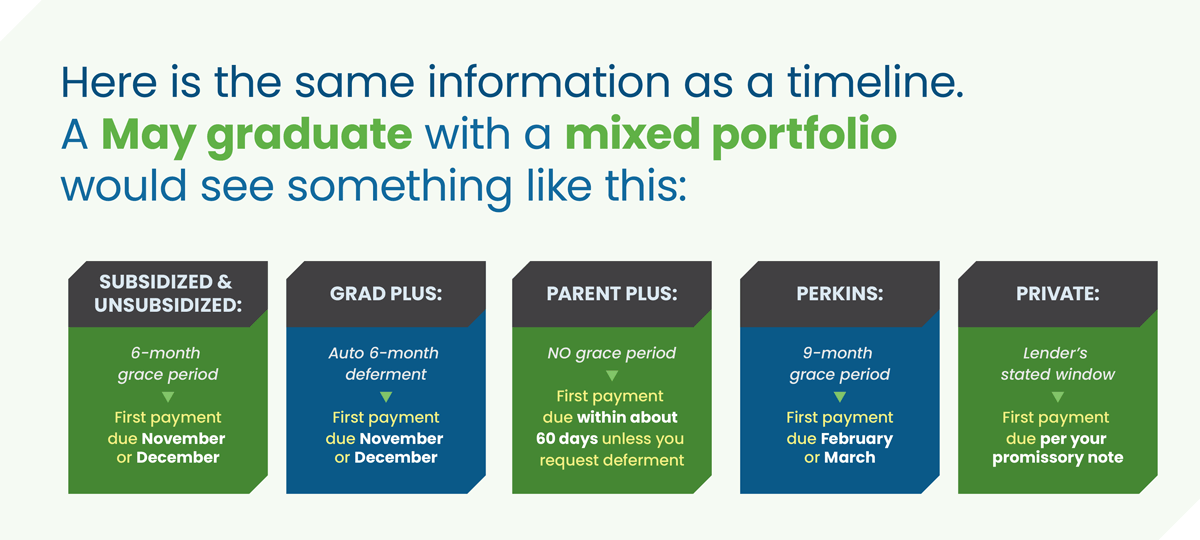
Your repayment clock starts the day your enrollment falls below half-time, and for most federal loans, your first payment is due six months later. That means a May graduate is looking at a first payment due date somewhere in November or December, depending on when the school reports the enrollment change.
Your school reports your status change to the National Student Loan Data System, which is what triggers the countdown. Your servicer then sends a billing statement before the first payment is due, so you shouldn’t have to guess the date.
What Triggers the Repayment Clock?
Three events start the grace period countdown on federal loans:
- Graduation: The clock starts when your program ends, not when your ceremony happens or when you receive your diploma.
- Withdrawing or leaving school: If you stop attending mid-semester, the school reports your last date of attendance.
- Dropping below half-time enrollment: Half-time enrollment is defined by your school, often six credit hours per term for undergraduates. If enrollment returns to half-time before the grace period runs out, the loans revert to in-school status, and the full grace period is preserved.
How to Find Your First Payment Due Date
Log in to your StudentAid.gov account dashboard, which shows your total balance, interest rate, current repayment plan, next payment due date, next payment amount, and a link to pay on your servicer’s site. That dashboard is the fastest way to see your loan details in one place for all federal loans.
Your loan servicer handles the billing. Before your first payment, the servicer sends a statement listing your payment due date, upcoming interest, payment amount, and payment instructions. Per Federal Student Aid’s guidance on preparing for student loan payments, your payment will be due no sooner than 21 days after the servicer sends that billing statement.
One servicer describes sending a repayment obligation with loan details plus a bill 20 to 25 days before the first payment is due. If that mail never arrives, the most common reason is an outdated address or email in your profile. This is why updating contact information with both your servicer and StudentAid.gov matters more during grace than at almost any other point.
When it comes to private loans, your first due date is listed in your promissory note, so check the loan agreement or log in to your lender’s portal.
Which Loan Types Have Different Timelines?
Grace period rules are split five ways:
- Subsidized loans have six months with no interest charge.
- Unsubsidized loans get six months, with interest.
- PLUS loans don't have a grace period. Grad PLUS loans get an automatic six-month deferment, and Parent PLUS loans get one on request.
- Legacy Perkins Loans carry nine months.
- Private loans will follow the lender's own contract.
| Loan Type | Grace Period | Interest During Grace | Action Needed |
|---|---|---|---|
| Direct Subsidized | 6 months | Government pays it | None, automatic |
| Direct Unsubsidized | 6 months | Accrues daily | None, automatic |
| Grad PLUS | None (automatic 6-month deferment) | Accrues daily | None, automatic |
| Parent PLUS | None | Accrues daily | Request 6-month deferment from servicer |
| Federal Perkins (legacy) | 9 months | Varies by loan | None, automatic |
| Private | Set by lender, often 6 months | Accrues daily in most cases | Check your loan agreement |
Direct Subsidized and Unsubsidized Loans
Both have the same six-month grace period, and the difference between them is who pays the interest during those months. On a Direct Subsidized Loan, the federal government covers interest while you are in school and during the grace period. On a Direct Unsubsidized Loan, interest accrues daily from the day the money is disbursed to your school and keeps accruing straight through graduation and the grace period.
The practical effect shows up in your first statement. Two borrowers who leave school with $25,000 each will not owe the same amount in month seven if one balance was subsidized and the other was not.
Because both loan types share the six-month timeline, most borrowers with a mix of the two get a single set of bills starting the same month, handled by the same servicer.
PLUS Loans and Six-Month Deferment
Graduate PLUS and Parent PLUS loans don’t have a grace period, but both offer a six-month deferment after school that functions like one. The difference is whether you must ask for it.
According to Federal Student Aid, graduate and professional students with PLUS loans are automatically deferred while enrolled at least half-time and for six months after they graduate, leave school, or drop below half-time enrollment. You don’t need to file anything.
Parent PLUS borrowers must request deferment themselves for the period the student is enrolled and for the six months after the student leaves school. Nothing happens automatically. This is the group most often caught off guard, because the loan is in the parent’s name while the enrollment status belongs to the student.
In both cases, interest accrues during the deferment, and it may be added to your principal when the deferment ends.
Grad PLUS borrowing regulations changed on 1 July 2026, as part of a broader federal overhaul. If you are a graduate student who borrowed before that date, your existing loans keep their original terms. Verify your specific loan status on StudentAid.gov instead of assuming.
Perkins Loans and the Nine-Month Rule
Federal Perkins Loans have a nine-month grace period, which is three months longer than Direct Loans.
Perkins Loans were school-based loans, and the program stopped issuing new loans in 2017. If you have one, you borrowed it years ago, and it may be serviced by your college or a school-designated servicer instead of one of the standard federal servicers.
That longer window sounds generous, and it is worth using deliberately. A nine-month gap means your Perkins bill arrives three months after your Direct Loan bills, which can make it easy to forget that a second payment obligation is coming.
Why Private Loan Terms Vary by Lender
Private student loan grace periods are set by the lender and written in your promissory note. Many private lenders offer six months, some offer nine, and a few require payments to begin shortly after you leave school.
Interest on private loans starts accruing when the money is disbursed, and the grace period rarely changes that.
Pull each promissory note and write down three things per loan: the stated grace period length, the interest rate, and whether accrued interest capitalizes when repayment starts.
If a private loan payment is already unaffordable, or it’s slipped into delinquency or default, refinancing is one path worth looking into. A student loan refinance replaces one or more private loans with a new fixed-rate loan.
Yrefy works exclusively with eligible private student loans, including delinquent and defaulted student loan balances, and offers fixed APRs from 0.1% to 5.99% for qualified borrowers with terms from 36 to 240 months. Yrefy looks at income, credit history, and debt-to-income ratio, among other factors, and does not require a minimum credit score. Federal loans are not eligible, and approval, rates, and savings depend on individual review.
Does Interest Accrue Before Your First Bill?
On every loan type except subsidized federal loans, yes. Interest builds daily during your grace period, and that unpaid interest typically gets added to your loan balance when repayment starts.
Federal Student Aid's repayment guidance states that for most loans, interest accrues during the grace period and is added to the outstanding balance as unpaid interest. It is not capitalized right away, but it still affects what you pay. Under a fixed payment plan, unpaid interest can increase your monthly payment. On an income-driven plan, it can stretch out how long you have to repay.
When the Government Covers Interest
Direct Subsidized Loans are the exception. The federal government pays the interest while you are enrolled at least half-time, during the six-month grace period, and during eligible deferment periods.
That means a subsidized balance of $20,000 at graduation is still $20,000 when your first payment comes due six months later. Nothing quietly grew in the background.
Subsidized loans are awarded based on demonstrated financial need and only to undergraduates, so if you carry graduate school debt, none of it is subsidized. Interest also resumes accruing on subsidized loans the moment the grace period ends, and periods of forbearance do accrue interest even on subsidized balances.
How Unpaid Interest Affects the Loan Principal
Capitalization is when accrued interest gets added to your loan principal. Once that happens, you pay interest on a bigger number.
On federal loans, the end of the grace period no longer triggers capitalization. On most private loans, it still does, so check your promissory note.
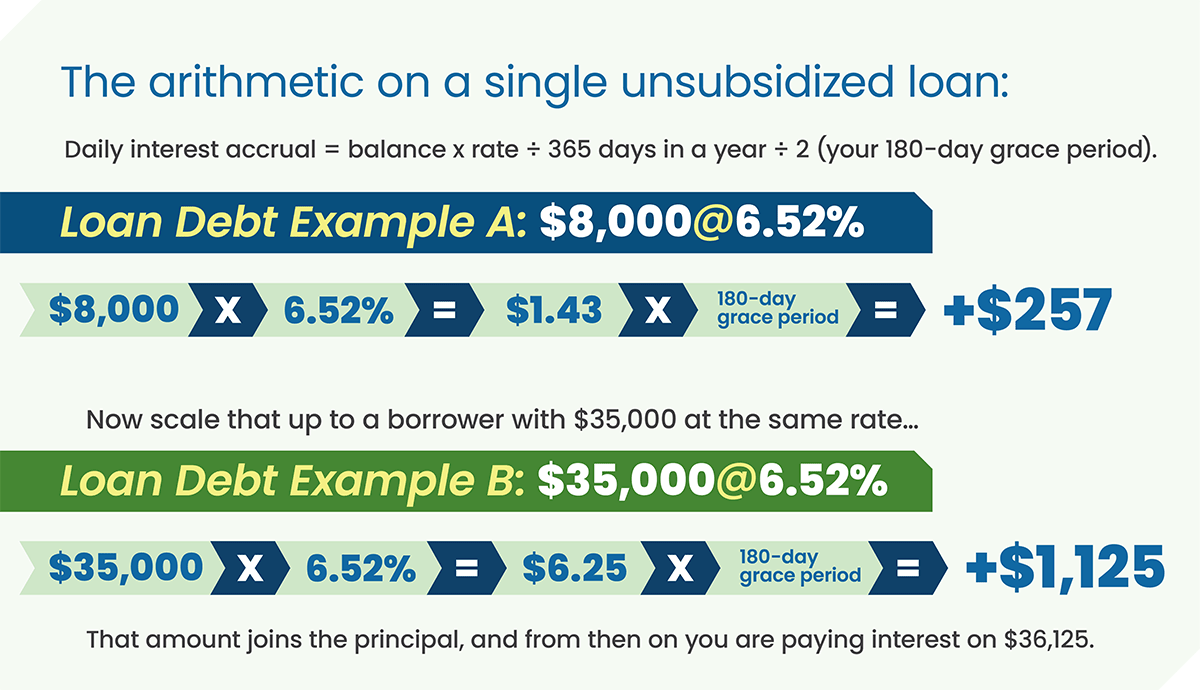
Here is the arithmetic on a single unsubsidized loan. Daily interest accrual on student loans is calculated as the balance times the rate, divided by the number of days in a year. For example, an $8,000 balance at 6.52% works out to about $1.43 per day, which comes to roughly $257 over a 180-day grace period.
Scale that up. A borrower leaving school with $35,000 in unsubsidized federal debt at the same rate would accrue around $1,120 in six months. That $1,120 stays on the account as unpaid interest. The borrower keeps paying interest on $35,000, but their first payments go toward the $1,120 before any of it reduces the principal.
If the same balance were a private loan that capitalizes at repayment, the $1,120 would be added to the principal, and from then on, the borrower would be paying interest on $36,120.
Should You Make Voluntary Payments?
If your budget allows, paying the accrued interest before repayment starts is the cheapest move available during the grace period. You aren't required to pay anything. On a private loan, paying off accrued interest prevents it from being added to your principal. On a federal loan, it means your first required payments start reducing principal right away instead of clearing old interest.
Two practical notes from experience helping borrowers through this stage:
- Target the interest, not the principal, if funds are tight: Knocking out accrued interest on your highest-rate loan does the most good. On a private loan, it prevents capitalization on the balance that costs the most.
- Tell your servicer where to apply the money: Payments made during grace can be applied in ways you did not intend. A quick call or a note in the payment portal clears that up.
Making some payments during grace may save you money later and reduce the total amount you repay. If your income during those six months is uneven, a smaller payment in a good month still reduces the amount that is capitalized.
How to Get Ready Before Payments Are Required
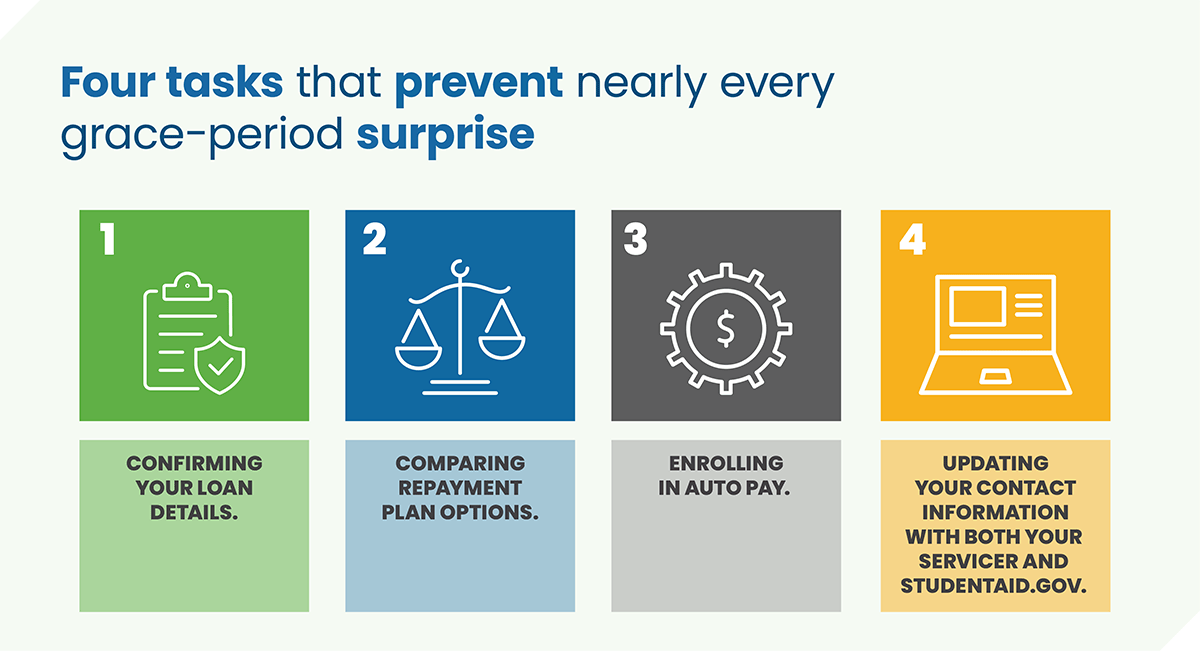
Exit counseling, which federal borrowers complete when leaving school, walks through much of this. Treat it as a starting checklist instead of a formality, because it is also where you can update the addresses and phone numbers your servicer uses to reach you.
Review Balances, Rates, and Servicer Information
Start by logging in to your StudentAid.gov account and listing every federal loan with its balance, interest rate, and assigned servicer. Borrowers routinely discover they have more separate loans than they thought, since each academic year’s borrowing is usually its own loan.
Then do the same for private loans through each lender’s portal. Here’s an example:
| Loan Type | Lender or Servicer | Balance | Rate | Fixed or Variable | First Payment Due |
|---|---|---|---|---|---|
| Direct Subsidized | Lender A | $5,500 | 5.50% | Fixed | Dec 15, 2025 |
| Direct Unsubsidized | Lender B | $6,500 | 5.50% | Fixed | Dec 15, 2025 |
| Private Student Loan | Lender C | $12,000 | 8.25% | Variable | Nov 28, 2025 |
| Federal Perkins | Lender D | $3,000 | 5.00% | Fixed | Mar 1, 2026 |
Filling that in takes maybe thirty minutes, and it becomes the reference you use for every decision that follows. If you cannot identify who services a federal loan, the StudentAid.gov dashboard lists it. Federal servicers include EDfinancial, MOHELA, Aidvantage, Nelnet, ECSI, and CRI.
Confirm your contact information in two places: your servicer’s website and your StudentAid.gov account’s settings. Incorrect contact information can cause you to miss notices about upcoming payments.
Compare Federal Repayment Plan Options
If you do nothing, you will be automatically enrolled in the Standard Plan or Tiered Standard Plan when you leave school, depending on when your loans were disbursed. The default is not always the lowest payment available to you.
Most borrowers can switch to an income-based plan. Under an income-driven repayment plan, monthly payments can be as low as $10, calculated based on your income and family size. Federal Student Aid recommends applying for an IDR plan up to 60 days before your grace period ends so your first payment falls under your chosen plan.
Federal repayment rules changed substantially in 2026, and existing income-driven plans were eliminated for borrowers who took out loans on or after 1 July 2026. Check which plans your specific loans qualify for before assuming an older plan is still open to you.
The overview of student loan repayment options covers the general categories, and the repayment calculator on StudentAid.gov will show which plan gives you the lowest monthly payment for your actual loan data.
Set Up Auto Pay and Protect Your Credit
Enroll in auto pay before your first payment due date. The Department of Education announced that federal borrowers enrolled in autopay by 30 September 2026 will receive a 1% interest rate reduction, effective through 30 June 2028, replacing the older 0.25 percentage-point discount. Signing up is free via your servicer’s website.
Autopay also protects your credit score by eliminating the risk of a missed due date. Missing a federal payment makes the loan delinquent the next day, and a delinquency of 90 days or more gets reported to all three national credit bureaus. After 270 days, a federal loan goes into default, which can lead to wage garnishment of up to 15% of your paycheck and seizure of tax refunds.
Many private lenders report delinquency after 30 days and may declare default after 90 - 120 days, so a private loan can damage your credit well before a federal one would. If a private loan is past due, options narrow but do not disappear.
What Can Change Your Repayment Timeline?
Four things move your first payment date: going back to school at least half-time, consolidating your federal loans, qualifying for a deferment, or active military duty. Each works differently, and one of them can shorten your grace period rather than extend it.
Returning to School and Enrollment Status
Re-enrolling at least half-time before your grace period ends returns your loans to in-school status and preserves the full grace period for when you leave again. This is one of the few situations where the six-month clock resets.
If you re-enroll after the grace period has already expired and repayment has begun, you can request an in-school deferment to pause payments, but you do not get a new grace period when you finish. Your loans go straight back into repayment.
Report enrollment changes promptly. Schools report to the National Student Loan Data System on their own schedule, and gaps in that reporting are a common cause of unexpected bills during a semester when you thought you were covered.
How Consolidation Can End the Remaining Wait
Consolidating federal loans during your grace period ends it early. Once you consolidate, you lose any remaining grace period, and payments become due within 60 days of consolidating.
Consolidation can lower your monthly payment by extending the repayment term and can make certain loans eligible for plans they could not access before. It also costs you the rest of your payment-free window.
The practical workaround: if consolidation makes sense for your situation, wait until your grace period is nearly over to submit the application. You keep the free months and still get the consolidated loan, even though repayment would have started anyway.
Federal consolidation and private refinancing are separate things.
Refinancing federal loans with any private lender permanently forfeits federal benefits, including income-driven repayment plans and Public Service Loan Forgiveness, which is why federal balances are generally left in the federal system when forgiveness is in play.
Military Service, Deferment, and Other Relief Options
Active-duty military service can extend a federal grace period for up to three years, according to Student Loan Borrowers Assistance’s summary of grace period rules. That extension is specific to active duty and is one of the longest available.
Beyond that, deferment and forbearance are the tools for pausing payments once repayment has started. Both require a request from your servicer, and interest can continue to accrue during either one, so a pause is not free. Deferment and forbearance can also affect eligibility for Public Service Loan Forgiveness and IDR plan discharge, since paused months usually do not count toward the required payment totals.
Private lenders set their own hardship policies. Yrefy's SKIP-12 program may allow qualifying borrowers to skip one payment every six months, up to 12 skipped payments over the life of the loan, with interest continuing to accrue during those periods. Military-deployment forbearance may be granted in 12-month periods with annual renewal.
Before your grace period ends, pull up your StudentAid.gov dashboard and each private lender’s portal, write down every first payment due date, and add those dates to a calendar with a reminder set two weeks ahead. That one list is what keeps the November bill from becoming a December delinquency.