
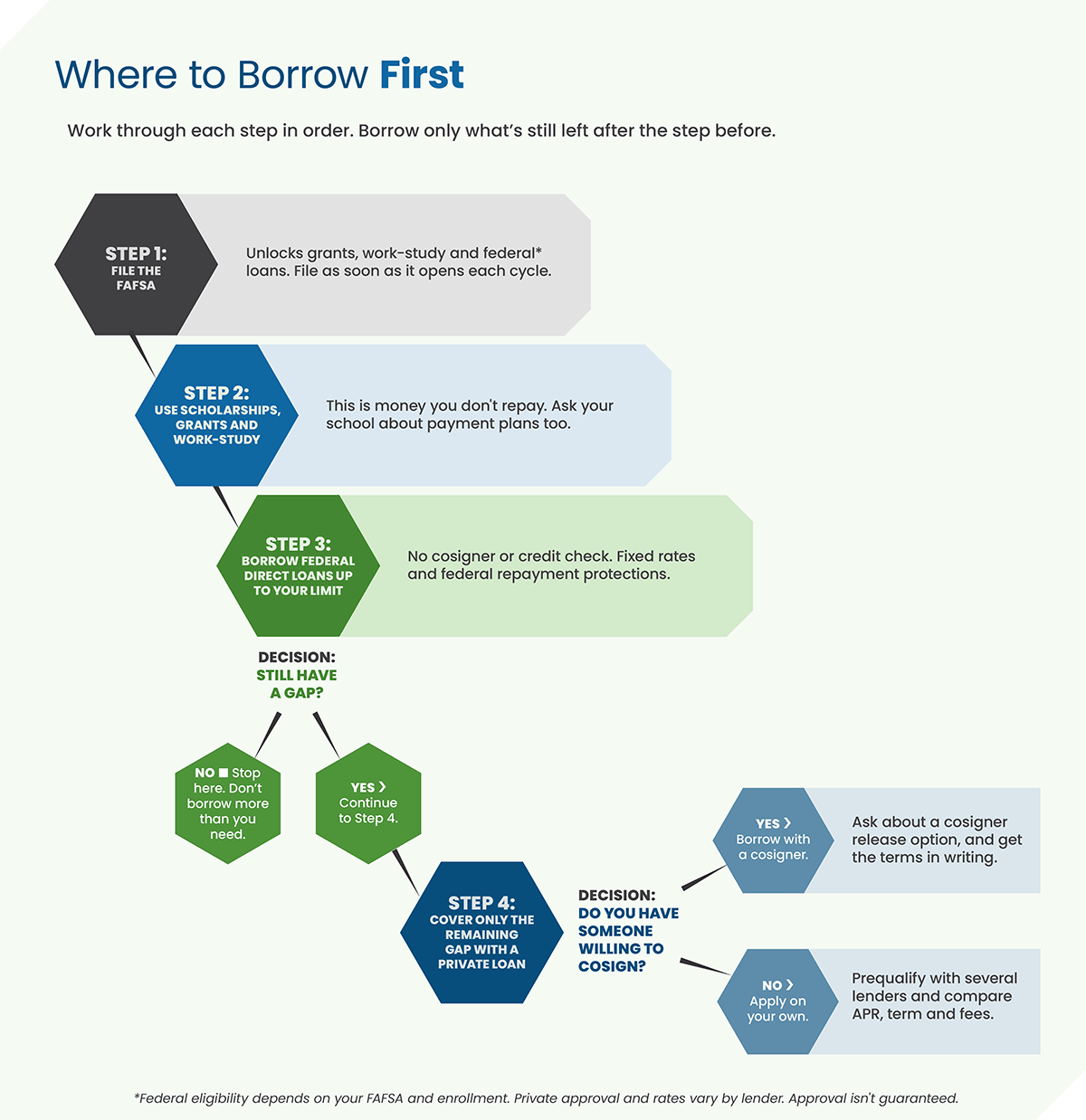
Not having a cosigner does not shut the door to paying for college. Federal Direct Loans, backed by the U.S. Department of Education, generally require no cosigner and no credit check.
For students without a creditworthy parent or relative willing to co-sign, or for adult learners rebuilding their finances on their own, the path forward starts with federal aid and turns to private lenders if a gap remains.
Private loans without a cosigner exist, too, but they look at your credit history, income, and sometimes your academic record instead of leaning on someone else’s credit file. Getting the best deal means understanding where to go first, what each option costs, and how to strengthen your application before you sign.
If you already have private student loans that have become hard to manage, resources like Yrefy's student loan refinance program and educational library can help you understand what solo refinancing looks like once you have an established payment history of your own.
Federal Student Loans that Don’t Require a Cosigner
When exploring student loans without a co-signer, federal student loans are the most reliable option available to U.S. citizens and eligible noncitizens pursuing a degree. They come from the Department of Education, not a bank, so approval is based on your FAFSA results and enrollment status rather than a credit score or income check.
Your first step is to complete the Free Application for Federal Student Aid, known as the FAFSA. This form determines your eligibility for a full financial aid package, including grants, work-study programs, and federal loans. Once processed, you receive a FAFSA Submission Summary that lays out your Student Aid Index and the aid you may qualify for at each school on your list.
Which Federal Direct Loans Do Not Require a Cosigner?
Direct Subsidized Loans and Direct Unsubsidized Loans do not require a cosigner or a credit check for the student borrower. These two federal loan options are available directly to undergraduate and graduate students, and neither depends on your credit history.
Because eligibility does not rely on a co-signer’s financial backing, these options represent the simplest student loan options available to students without a co-signer.
Direct PLUS Loans are available to parents of dependent undergraduates and to graduate or professional students, but they do require a credit check and a review of adverse credit history, and a parent with credit problems may need to secure an endorser, who functions like a cosigner.
Direct Subsidized and Unsubsidized Loans - How Eligibility Actually Works
Eligibility for these loans depends on your enrollment status and financial need, not your credit. Direct Subsidized Loans go to undergraduates who show financial need through their FAFSA results, and the government pays the interest while you’re enrolled at least half-time, during your grace period, and during deferment. Direct Unsubsidized Loans are open to undergraduate, graduate, and professional students regardless of financial need, though interest starts accruing as soon as the loan is disbursed. Both loan types skip the credit check entirely, which makes them the most accessible borrowing option for students without an established credit history or income.
Understand PLUS Loan Credit Rules and 2026 Changes
PLUS Loans require a credit check, and new borrowing caps took effect this year. Beginning 1 July 2026, Parent PLUS borrowing is capped at $20,000 per dependent student per year, with a $65,000 lifetime limit per student.
The Graduate PLUS program has been eliminated for new borrowers, according to Nolo's summary of federal student loan changes. Graduate students who previously counted on Grad PLUS Loans to cover costs beyond the unsubsidized limit now face a real funding gap, which is one reason more graduate borrowers are exploring private no-cosigner loans this year.
Advocacy groups have noted that a significant share of borrowers affected by the new graduate loan caps have poor or limited credit, which could push them toward private lenders who evaluate risk differently than the federal government does.
How to Borrow Federal Student Loans Without a Cosigner
Borrowing federal loans without a cosigner starts with the FAFSA and follows a predictable yearly limit based on your year in school and dependency status. No credit check, no income verification, and no parental signature is required for Direct Subsidized or Unsubsidized Loans, though dependent students do need a parent’s information on the FAFSA itself, even though the parent isn't cosigning the loan.
Filling Out the FAFSA Before Private Borrowing
File your FAFSA before you consider any private loan application. The form unlocks your full financial aid package, including scholarships, grants, work-study earnings, and federal loans, and most need-based aid is awarded first-come, first-served, so applying as soon as the form opens each cycle improves your odds, as explained in Forbes Advisor's guide to financial aid for adult students. Skipping this step and going straight to a private lender means giving up fixed federal rates, income-driven repayment, and deferment options you may need later. Even if you expect your family’s income to disqualify you from need-based grants, submit the form anyway. It’s also required for federal work-study and many state and institutional aid programs.
Current Federal Loan Limits by Year
Federal loan limits increase gradually as you advance through school and depend on whether you’re claimed as a dependent. A first-year dependent undergraduate can generally borrow $5,500 in combined Direct Subsidized and Unsubsidized Loans, with no more than $3,500 of that in subsidized loans.
Loan limits rise in later years, and independent students can typically borrow more in unsubsidized loans than dependent students at the same grade level. Check your school’s financial aid office or your FAFSA Submission Summary for your exact limit, since your cost of attendance, as certified by your school, also factors into how much you can borrow.
How to Borrow Private Student Loans Without a Cosigner
Qualifying for private student loans without a co-signer is possible for students who have exhausted federal aid or need help covering tuition gaps. Lenders, including Ascent, Funding U, MPOWER Financing, Citizens, College Ave, Sallie Mae, and Earnest, each offer some form of solo-qualifying private student loan, though the underwriting standards and loan amounts vary significantly by lender.
What Lenders Look for Instead of a Cosigner (Credit, Income, Outcomes-Based Underwriting)
Private lenders replace the cosigner’s credit backing with your own credit score, income, or, in some cases, your academic outcomes. Some lenders evaluate a traditional credit profile, checking your credit score, credit history, and debt-to-income ratio, the same way they would for a cosigner.
Others, particularly those marketed to students with no credit history, use outcomes-based underwriting that instead weighs your GPA, major, school, and projected earning potential. Funding U, for example, offers merit-based loans of up to $20,000 per year, based on a student’s academic profile rather than a credit score, according to Funding U’s guide to no-cosigner student loans. MPOWER Financing focuses on international students and DACA recipients who typically lack a U.S. credit history, evaluating future earning potential and academic standing instead.
Who Can Qualify for a Private Loan on Their Own?
Qualifying on your own generally requires some combination of an established credit history, steady income, or a strong academic profile, depending on the lender you choose. Juniors and seniors with a track record of on-time credit card payments or a few years of steady income have an easier time than first-year students with no credit file at all, according to Forbes’ reporting on cosigner requirements for private student loans.
If you’re a graduate student with a job and a credit history, you may qualify with a traditional private lender. If you’re an undergraduate with no credit and no income, a merit-based lender that evaluates your GPA and major may be a more realistic option.
Why Do Most Applicants Still Add a Cosigner
Most private student loan borrowers add a cosigner because it improves approval odds and often lowers the interest rate. About 93% of private student loans are cosigned, largely because undergraduates without a long credit history struggle to qualify on income and credit alone. A cosigner with strong credit gives the lender extra assurance that the loan will be repaid, which can translate into a lower APR than a solo applicant would receive from the same lender.
Strengthening a Solo Loan Application
Building a stronger application before you apply can mean the difference between denial and an approval with reasonable terms. Small, deliberate steps, taken months before you need the money, put you in a better position, whether you’re applying for a private loan on your own or preparing to add a cosigner as a backup plan.
Build Credit Before You Apply
Building credit takes time, but even a few months of consistent history can help. Becoming an authorized user on a family member’s credit card, opening a secured credit card, or using a credit-building product like Self that reports to the credit bureaus are common starting points. Keep your credit utilization low and make every payment on time.
You can check your credit report for free through AnnualCreditReport.com, and reviewing it before you apply lets you catch and dispute errors that could hurt your chances of approval. Building credit doesn’t guarantee approval, since lenders weigh other factors too, but it strengthens your file no matter which lender you approach.
Use Prequalification to Compare Offers
Prequalifying with several lenders lets you compare real rate estimates without hurting your credit score. Most reputable private lenders offer a soft credit pull for prequalification, which shows you an estimated APR and terms without the hard credit inquiry required for a full application. Gather your recent pay stubs or W-2s, your Experian or other credit report, and basic information about your enrollment before you start, so you can move through several pre-qualification checks quickly. Compare the APR, loan term, fees, and repayment options side by side before committing to a full application with any single lender.
Consider a Cosigner and a Future Release Option
Adding a cosigner, even temporarily, often unlocks a lower rate and easier approval than borrowing alone. If you have someone willing to cosign, ask whether the lender offers a cosigner release option, which lets the cosigner come off the loan after you make a set number of consecutive on-time payments and meet the lender’s credit and income requirements on your own. This gives you the benefit of a cosigner’s credit at the start while working toward full independence on the loan later. Confirm the release terms in writing before you or your cosigner signs anything, since requirements vary widely by lender.
Pros and Cons: Federal vs. Private No-Cosigner Loans
Federal loans offer fixed rates set by law, income-driven repayment, and forgiveness programs that private lenders don't match, while private no-cosigner loans offer higher borrowing limits and can fill gaps once federal aid runs out. The tradeoff comes down to cost, flexibility, and the safety net you keep if your finances get tight after graduation.
Compare APR, Loan Terms, and Total Interest
Federal loan rates are fixed by Congress and apply equally to every borrower, while private no-cosigner loan rates depend on your individual credit, income, or academic profile. Private no-cosigner loans commonly carry higher rates than federal loans because there’s no cosigner backing the debt, and you should compare any private offer against the current federal undergraduate rate, which is 6.52% for loans first disbursed between 1 July 2026 and 30 June 2027, according to the federal student loan interest rate schedule.
Loan terms also differ: federal standard repayment runs up to 10 years for most Direct Loans, while private lenders set their own terms, often ranging from several years to two decades, depending on the lender and loan amount.
| Feature | Federal Direct Loans | Private No-Cosigner Loans |
|---|---|---|
| Credit check | No (most undergrad loans) | Yes, or the academic profile used instead |
| Cosigner required | No | No, but often improves terms |
| Interest rate type | Fixed, set by law | Fixed or variable, set by the lender |
| Income-driven repayment | Yes | Rarely offered |
| Deferment/forbearance | Yes | Varies by lender |
| Typical loan limits | $5,500-$12,500/year (undergrad) | Varies; some up to $20,000/year |
What You Gain and Give Up with Each
Federal loans give you income-driven repayment, deferment, forbearance, and eligibility for Public Service Loan Forgiveness, protections that follow the loan for its entire life. Private no-cosigner loans give up most of those borrower protections in exchange for higher borrowing limits and, in some cases, faster approval. Some private lenders offer their own hardship options, like temporary payment reductions or forbearance periods, but these are set by the lender and can change, unlike federal protections that are written into law.
A Real Cost Comparison on $10,000 Borrowed
A $10,000 loan at the current federal undergraduate fixed rate of 6.52% over a 10-year term costs meaningfully less in total interest than the same amount borrowed privately at a higher rate. As an illustration, $10,000 at 6.52% runs roughly $114 a month, while an 11% private no-cosigner loan runs closer to $138 a month.
Over time, the higher private rate significantly widens the interest gap.
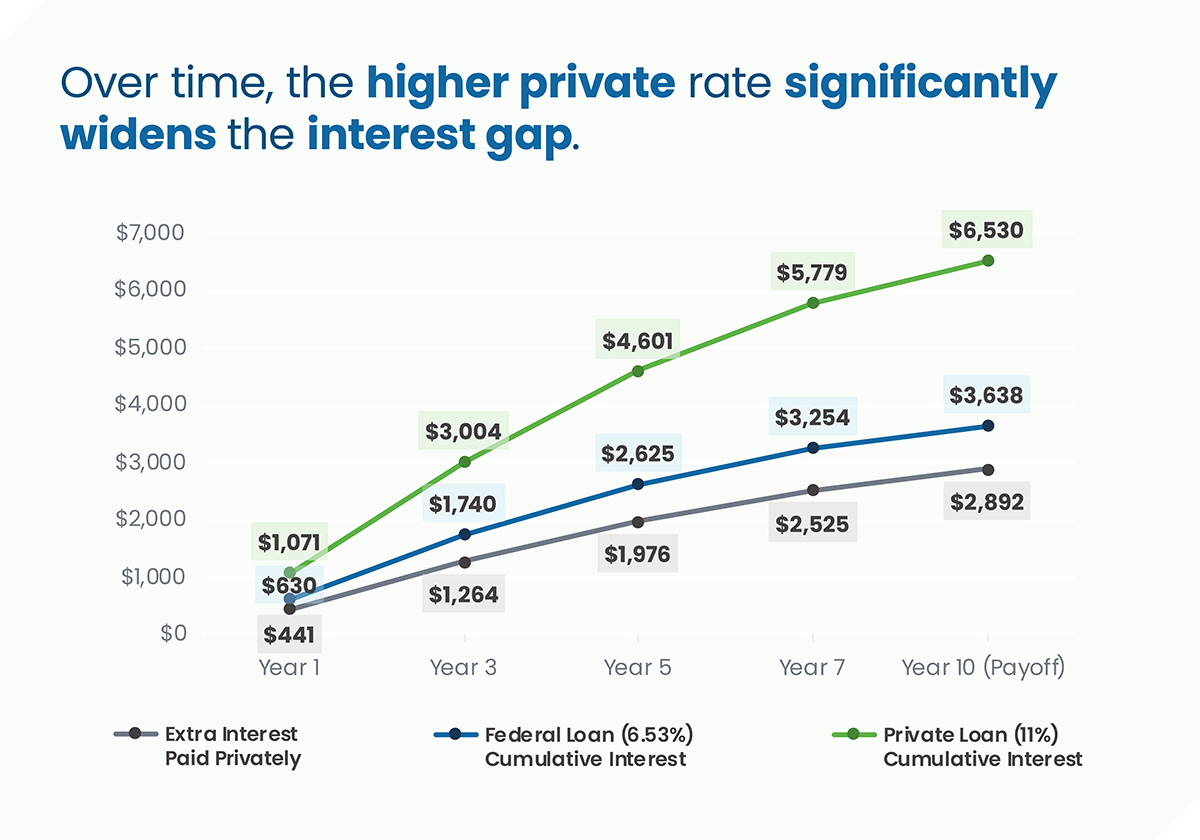
These figures are illustrative only. Your actual APR, term, and payment will depend on the lender, repayment plan, and your financial profile.
Why Fixed Rates Can Be Easier to Budget For
A fixed interest rate keeps your monthly payment the same for the life of the loan, which makes long-term budgeting simpler. A variable interest rate can start lower but moves with the market, so your payment could climb well beyond what you first agreed to. All federal Direct Loans carry fixed rates by law, while private lenders offer both fixed and variable options, so confirm which type you’re being offered before you accept any private loan.
Alternative Funding Worth Considering Before Loans
Reducing what you borrow starts with the money you never have to repay. Scholarships, grants, and payment plans can shrink your funding gap before you take on any loan, federal or private, and every dollar you don’t borrow is a dollar you won’t owe interest on later.
Scholarships, Grants, and School Payment Plans
Scholarships and grants cover a bigger share of college costs than many students realize. About 61% of families used scholarships to help pay for college in 2023, receiving an average of $7,822 per student, according to NerdWallet's report on paying for college.
Federal Pell Grants, which do not need to be repaid, are capped at $7,395 for the 2026-27 academic year, and the Federal Supplemental Education Opportunity Grant can add up to $4,000 more, according to Forbes Advisor's overview of federal grant programs. Many schools also offer interest-free monthly payment plans for tuition, which can ease cash flow without adding debt. Ask your financial aid office about institutional scholarships, payment plans, and emergency aid before assuming a loan is your only option.
When It Makes Sense to Wait or Reduce What You Borrow
Delaying enrollment, choosing a lower-cost school, or working part-time can all shrink the amount you eventually need to borrow. Starting at a community college before transferring to a four-year school, working while enrolled, or taking a gap period to build savings and credit are all reasonable ways to reduce your reliance on private no-cosigner loans. None of these choices reflects poorly on your ambitions. They simply put you in a stronger financial position before you take on debt that will follow you for years.
Federal Direct Loans remain the premier student loans without a co-signer, since they skip the credit check entirely and offer fixed rates and repayment protections that private lenders don’t provide. File your FAFSA first, borrow up to your federal limit, and only turn to a private no-cosigner loan to cover what remains.
If you apply through private lenders like Ascent, Funding U, or MPOWER Financing, compare APRs, loan terms, and total interest carefully before you sign. If private borrowing becomes hard to manage later, resources like Yrefy's bad credit refinancing information can help you explore refinancing on your own once you build your payment history.
Frequently Asked Questions
Can an 18-year-old get a student loan without a cosigner?
Yes. An 18-year-old can qualify for Direct Subsidized and Unsubsidized federal loans without a cosigner or credit check, since eligibility is based on FAFSA results and enrollment status. Private no-cosigner loans are harder to get at 18 without an established credit history or income, so federal aid should be the first step.
Can I get a student loan without a cosigner and no credit history?
Federal Direct Loans require no credit history at all, making them the most realistic option if you have no credit file. Some private lenders, such as those offering merit-based underwriting, evaluate your GPA, major, and projected earnings rather than your credit score, but approval still isn’t guaranteed.
Can I get a student loan without a cosigner and no income?
Federal loans do not require proof of income for approval, so you can qualify without a job or a steady paycheck. Private lenders without a cosigner generally do check income, so a lack of steady income can limit your private loan options until your financial profile improves.
Is approval for a no-cosigner student loan guaranteed?
No approval is ever guaranteed for federal or private loans. Federal aid depends on your FAFSA eligibility and enrollment status, while private lenders set their own credit, income, or academic thresholds that vary by company.
What should I do if no one cosigns my student loan?
Start with the FAFSA to secure federal loans, grants, and work-study funds that don’t require a cosigner. If a gap remains after federal aid, compare private lenders that evaluate solo applicants on credit, income, or academic merit, and talk to your school's financial aid office about scholarships or payment plans that could reduce how much you need to borrow.
Can I refinance a private student loan later if I borrow without a cosigner?
Refinancing a private student loan without a cosigner is possible later, once you've built enough credit history and income to qualify on your own. Refinancing eligibility, rates, and terms depend on your financial profile at the time you apply, and outcomes vary by lender.