
The End of the SAVE Plan: What’s Changing?

Table of Contents
Time Sensitive Changes to the SAVE Plan
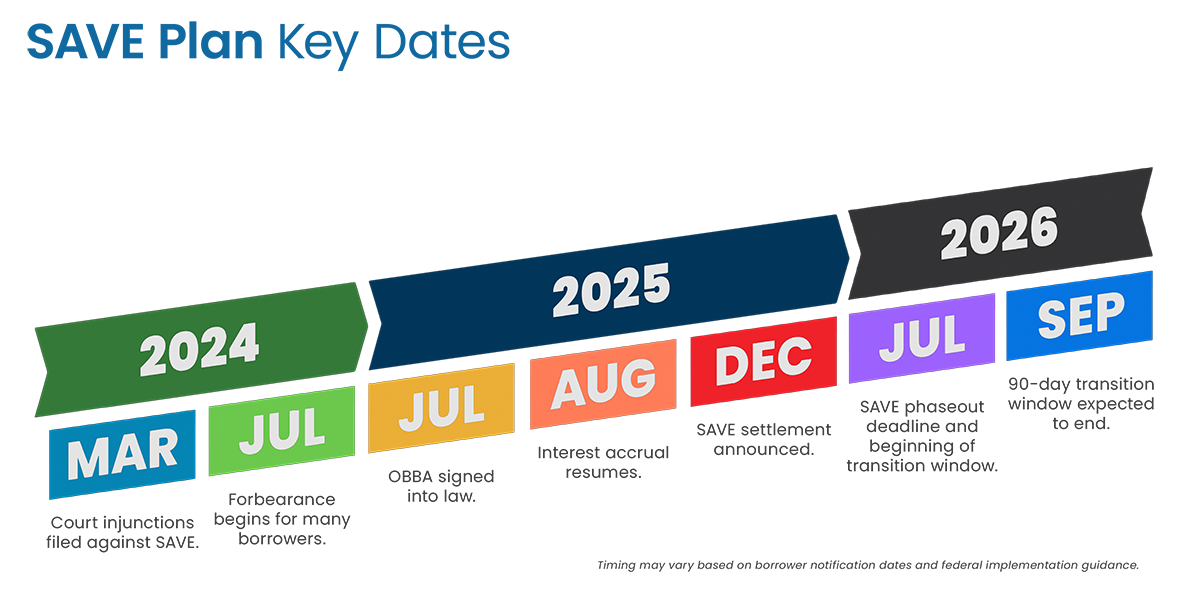
For nearly two years, the SAVE plan (aka Saving on a Valuable Education) has been in legal limbo after court challenges were filed in March 2024. Payments were paused for many borrowers after court injunctions blocked parts of the program, which led to significant confusion regarding interest accrual, forgiveness credit, and future repayment options.
For borrowers currently enrolled in the SAVE plan, there is time-sensitive news: the SAVE plan is expected to end on July 1, 2026, and current Department of Education guidance and reporting indicates that borrowers may receive approximately 90 days to select a new repayment plan.
If you are currently enrolled in SAVE, or were considering enrolling before applications were frozen, understanding what happens next is critical.
What Was the SAVE Plan and Why Is It Ending?
The SAVE plan was introduced by the Biden administration as an Income-Driven Repayment (IDR) Plan designed to reduce monthly payments and limit balance growth caused by unpaid interest.
How SAVE Worked and Who Was Enrolled
SAVE was rolled out in 2023 as a replacement for a separate IDR plan then known as REPAYE (Revised Pay As You Earn). The SAVE plan was unique because it expanded the protected income threshold for borrowers and also included an interest subsidy that prevented some borrowers’ balances from ballooning, so long as they were making minimum payments. In many cases, SAVE lowered monthly payments for undergraduate loan borrowers, and accelerated the forgiveness timeline to 10 years for eligible borrowers with balances of $12,000 or less.
SAVE significantly changed repayment calculations for many borrowers, which is why, according to the Department of Education’s own reporting, at least 7.5 million borrowers enrolled in the plan.
The Legal Challenges That Put SAVE in Limbo
After SAVE was implemented, multiple states filed lawsuits challenging the Department of Education’s authority to create and expand the plan. The lawsuits primarily argued that the Biden administration exceeded its authority under the Higher Education Act by reducing repayment obligations and expanding forgiveness pathways without congressional approval.
In March 2024, federal court injunctions began blocking portions of the SAVE plan while litigation moved through the court system. As the legal battle continued, the Department of Education placed many SAVE borrowers into administrative forbearance. During this time, many borrowers experienced suspended or reduced interest accrual for a period that ended on August 1, 2025.
The One Big Beautiful Bill Act and SAVE’s Official End
The fate of the SAVE plan was shaped by a negotiated settlement between the U.S. Department of Education and the State of Missouri, along with broader federal policy changes to the student loan repayment system.
In December 2025, the Department of Education announced a proposed settlement that would phase out the SAVE plan, halt new enrollments, and require all current SAVE borrowers to transition into other federal repayment plans. The agreement was intended to resolve ongoing litigation and reduce uncertainty for borrowers who had been placed into administrative forbearance since 2024.
While the settlement still required court approval at the time of the announcement, subsequent reporting suggested the settlement and legal process continued into 2026. At the same time, larger federal policy changes to the student loan repayment system, including provisions associated with the One Big Beautiful Bill Act (OBBBA), changed the structure of available IDR repayment options going forward.
There was no single endpoint of the SAVE plan, but a combination of overlapping actions in court, the Department of Education, and in Congress.
Where Things Stand Right Now
Tracking the SAVE plan’s status through federal law changes, policy updates, and lawsuits is not an easy task. The Department of Education had to create a court-actions webpage just to track it all.
In short, for borrowers currently in SAVE, a structured transition period is beginning.
Current Borrower Status (Forbearance, Interest, and Payments)
Many borrowers enrolled in SAVE were placed into administrative forbearance beginning in 2024 due to legal and policy uncertainty. However, the status of interest accrual and forgiveness credit has varied. As a result, borrowers may currently be in different stages of repayment, forbearance, or transition, depending on when they were placed into forbearance, whether they resumed payments, and how their loan servicer applied Department of Education guidance.
This has contributed to ongoing confusion about repayment status, interest accrual, and forgiveness progress.
As the transition process moves forward, Department communications have indicated SAVE borrowers may receive transition notices in 2026. Multiple reports also indicate borrowers who do not select a new repayment plan within the required timeframe may be automatically moved into another repayment structure.
Timeline: When Does SAVE Actually End?
According to the Department of Education, notices are expected to be sent to borrowers enrolled in SAVE plan starting July 1, 2026, which will kick off the transition period for borrowers to exit SAVE through a structured notification and plan selection process.
Once a borrower receives an official notice, they are expected to receive a 90-day window to select a new eligible federal repayment plan. This includes options such as the Standard Repayment Plan or other qualifying federal repayment plans, depending on eligibility.
If a borrower does not select a new plan within the required timeframe, the Department of Education may automatically transition some borrowers into another repayment structure in order to ensure continuous repayment.
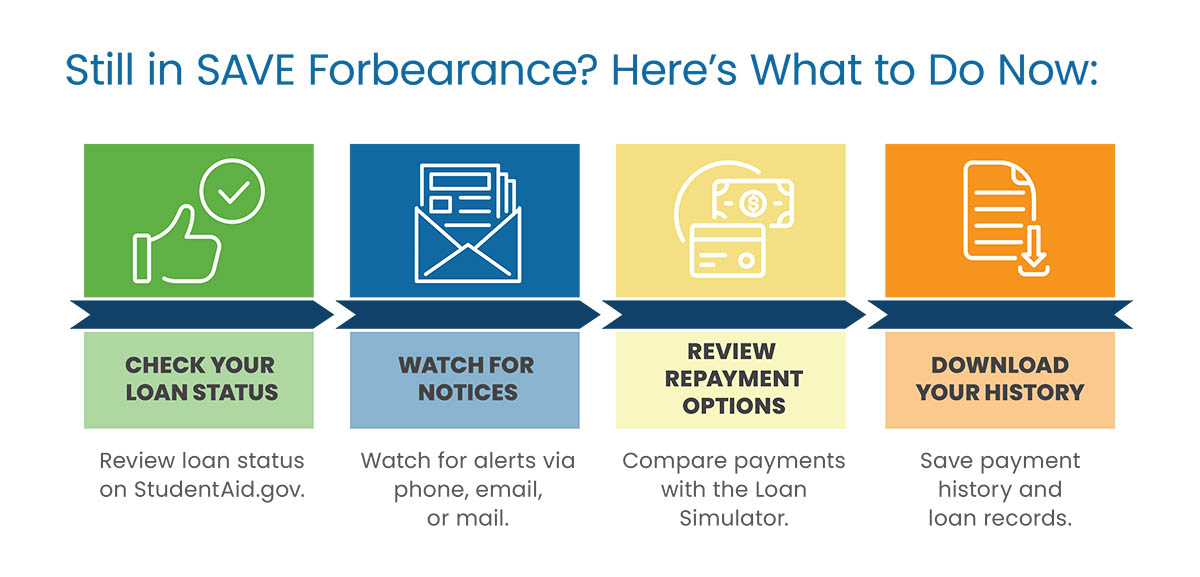
Borrowers who must transition to a new plan should review the Loan Simulator on StudentAid.gov, and stay current with Department of Education updates via their student aid announcements page.
What the Department of Education Has Said
The Department of Education has consistently communicated that borrowers will not be left without repayment options during the transition away from SAVE. This includes ensuring that borrowers are moved into available federal repayment plans, including income-driven and standard repayment options, depending on eligibility.
The Department has also emphasized that implementation will occur in stages, with borrower communication and servicer notifications guiding individuals through plan changes.
This does not mean the process will be flawless. Borrowers should expect their loan servicer to be their primary source of information, as student loans are unique, and impacts from policy changes may vary according to loan type, status, and balance.
What Are Your Options Going Forward?
While the available federal repayment plans will vary based on loan type, borrowing history, and eligibility, most borrowers will generally be moved into one of several core federal repayment paths.
Income-Based Repayment (IBR) Still Available
For borrowers transitioning out of SAVE, Income-Based Repayment (IBR) offers similar income-based payment flexibility, but without some of SAVE’s key features like interest protections. IBR is a type of repayment plan under Income-Driven Repayment.
Details include:
- Monthly payments are calculated based on a borrower’s income and family size.
- IBR plans may offer forgiveness after 20 or 25 years of qualifying payments (restrictions and eligibility apply).
- Includes a built-in payment cap. A borrower’s calculated income-based payment will not generally exceed what they would pay under a standard 10-year repayment plan.
- Payments are generally set at 10% or 15% of discretionary income, depending on when the borrower first took out eligible federal student loans. Discretionary income is defined as income above 150% of the federal poverty guideline (for families living in the 48 contiguous states or District of Columbia), which is used to determine how much of a borrower’s income is considered available for repayment.
IBR payments are adjusted annually, which means borrowers must recertify their income and household size each year. This can cause monthly payments to increase or decrease depending on earnings or family changes.
The New Repayment Assistance Program (RAP)
The Repayment Assistance Program (RAP) is a new federal repayment plan created under recent changes to the federal student loan system, and is expected to begin in 2026 per the Congressional Research Service.
RAP is not yet fully published on the Department of Education’s borrower-facing site, but it is scheduled to become available to eligible borrowers starting July 1, 2026. Key features of RAP are expected to include (but are subject to change):
- Monthly payments based on Adjusted Gross Income (AGI), with payments generally ranging from 1% to 10% of income.
- Adjustments for family size and a feature designed to prevent balances from growing unchecked when payments are low. In some cases, unpaid interest may be reduced or offset under the plan’s structure.
- Repayment timelines up to 30 years, after which remaining balances may be forgiven.
For borrowers leaving SAVE, RAP is expected to become a major federal income-based repayment option if implemented as currently proposed.
SAVE vs. IBR vs. RAP
| SAVE | IBR | RAP | |
|---|---|---|---|
| Payment Structure | Based on income above 225% of poverty guideline | 10% or 15% of discretionary income | Expected to range from 1% to 10% of AGI |
| Interest Treatment | Included unpaid interest protections | Limited unpaid interest protections | Expected to include balance growth protections |
| Forgiveness Timeline | 10-25 years | 20 or 25 years | Up to 30 years |
| Plan Status | Ending July 2026 | Available to eligible borrowers | Expected to begin July 2026 |
Repayment terms and eligibility may change based on future federal guidance.
Standard and Graduated Repayment Plans
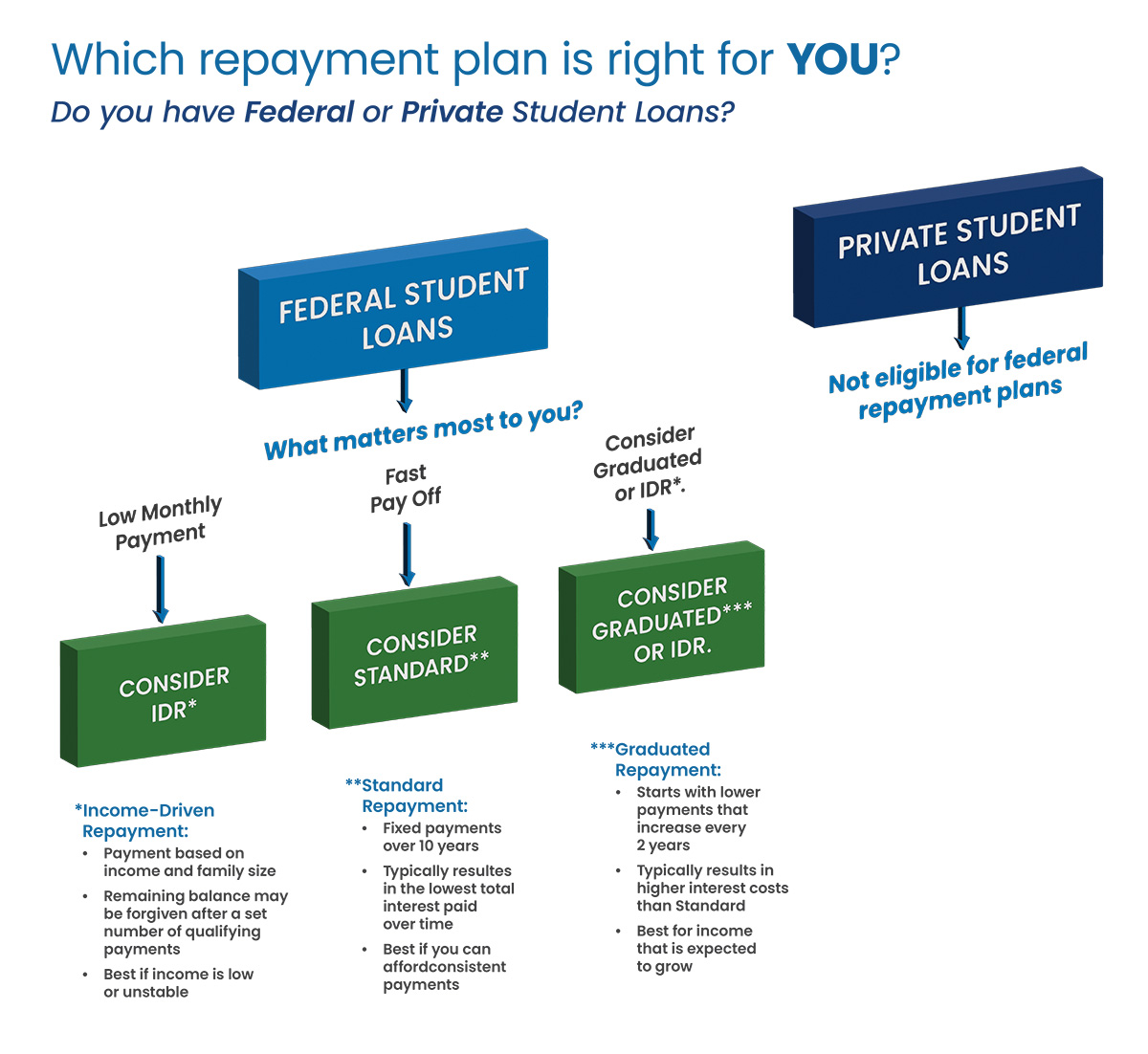
For borrowers transitioning out of SAVE, standard or graduated repayment options may be worth considering. While IDR plans adjust based on earnings or family size, Standard and Graduated Repayment Plans are based on fixed loan terms and repayment schedules.
The Standard Repayment Plan uses fixed monthly payments over a set period, typically designed to fully repay the loan within 10 years (or up to 30 years for certain consolidation loans). Payments remain the same throughout the life of the loan, which provides predictability. Because repayment is structured to pay off the balance within a fixed timeline, borrowers often pay less interest over time compared to graduated or IDR repayment plans.
The Graduated Repayment Plan also follows a fixed repayment term, but payments start lower and increase over time, usually every two years. This structure is designed for borrowers who expect their income to grow steadily after leaving school or who are entering the workforce. While early payments are more affordable, total interest costs may be higher compared to standard repayment.
Standard repayment generally offers stability and faster payoff potential, while graduated repayment provides short-term payment relief with increasing payments over time. It’s important to note that these options may have a higher payment than what borrowers previously experienced with SAVE, and a loan simulator should be used to compare total costs and monthly payments before proceeding.
Public Service Loan Forgiveness: What Still Applies
Public Service Loan Forgiveness (PSLF) remains unchanged in its core structure and continues to operate separately from repayment plans like SAVE or IBR.
Eligible borrowers working full-time for qualifying government or nonprofit employers may still receive forgiveness after making 120 qualifying monthly payments under an eligible repayment plan. These payments must be made while employed in a qualifying role, and the borrower must meet all certification and documentation requirements.
Importantly, PSLF eligibility is tied to qualifying employment and qualifying payments, not to participation in a single repayment plan. This means borrowers transitioning out of SAVE may still remain on track for PSLF as long as they move into another eligible repayment plan and continue to meet program requirements.
What This Means for Your Forgiveness Timeline
One of the biggest questions for those enrolled in SAVE or moving out of the plan is how these changes affect progress toward loan forgiveness. Before reading the next section, it’s important to understand that guidance regarding the transition is actively changing, because of this the below information could change. For the most up-to-date information regarding federal repayment plans and borrower guidance, please visit StudentAid.gov.
How Plan Transitions Affect Forgiveness Progress
Borrowers may retain prior qualifying forgiveness payment credit when transitioning plans, depending on applicable program rules and guidance.
However, the transition period is creating complexity.
Borrowers may be required to move between different repayment structures (SAVE, IBR, Standard, or RAP), and not all plans treat forgiveness credit in the same way. In some cases, time spent in administrative forbearance or non-qualifying repayment periods may not count toward forgiveness, even if payments were paused due to policy changes or legal actions.
Because of this, borrowers are encouraged to carefully review their loan history before changing plans. They should also download or document all payment history and loan status information. Be prepared to speak with your loan servicer with documented proof of your payment history.
Tax Implications of Future Forgiveness
Student loan forgiveness can have tax implications.
In some cases, forgiveness under federal programs such as Public Service Loan Forgiveness has not been treated as taxable income at the federal level. However, other types of forgiveness tied to income-driven repayment have had different tax treatments in past years, depending on applicable federal and state laws at the time.
Because tax treatment can change based on federal legislation and IRS guidance, borrowers should not assume forgiveness will always be tax-free. As a best practice, borrowers should review potential tax implications with a tax professional as they approach forgiveness eligibility.
If You Also Have Private Student Loans
When federal repayment plans like SAVE change, borrowers with both federal and private student loans may feel added uncertainty across their overall debt profile. Taking control of private student loans starts with understanding that, unlike federal loans, repayment terms are set by the lender and do not change with federal repayment plan updates.
Taking Control of Your Private Loans When Federal Policy Feels Uncertain
Private student loans do not include federal repayment options such as income-driven repayment plans or forgiveness programs. Instead, repayment is based on the terms set by the lender.
Because of this, control comes from reviewing the details of the loan itself. This includes understanding current interest rates, monthly payment amounts, and whether refinancing could lower total costs or improve your monthly cash flow.
Next Steps and Final Considerations
The end of the SAVE plan marks a big change for many federal student loan borrowers, and how they will approach repayment going forward. For most people, the immediate priority is understanding which repayment plan they will move to and how that choice affects monthly payments, interest, and long-term forgiveness progress.
While federal repayment plans may be changing, your private loans don’t have to feel like a moving target.
If delinquent or defaulted private student loans are causing financial strain, Yrefy may be able to help. Yrefy works with borrowers who may not qualify for traditional refinancing, including those with bad credit (eligibility requirements and terms apply).
To learn more, contact us at (888) 358-3359 or fill out our contact form, and a member of the team will reach out.
Disclaimer: This article is for informational purposes only and should not be considered legal, tax, or financial advice. Please consult a qualified financial advisor or attorney regarding your specific student loan situation.