

Student Loans and Marriage: The Complete Financial Guide for Couples

Table of Contents
Introduction
Marriage changes a lot about life, like living situations, daily routines, hobbies, and long-term financial plans.
Marriage can also change student loan payments, sometimes in a big way.
While certainly not as much fun as wedding planning, financial planning for marriage should include honest discussions about student loans. If this feels embarrassing, just remember: millions of Americans have student loan debt, and talking openly with your spouse about it in advance will make financial planning as a couple much easier.
Our team at Yrefy put together this guide to help with some of those early financial conversations with your spouse. We’ll review the potential impacts of marriage on student loans, and then move on to more advanced topics such as taxes and federal vs. private loans. We’ve also included an easy decision framework to help you determine what might be the best way to file taxes for your family.
How Marriage Changes Your Student Loan Game
Couples often assume their student loan payments will remain the same after their wedding. In some cases, that may be true. However, how those student loans fit into a couple’s overall financial profile will change.
Following marriage, your income and tax filing status may change as a result of your spouse. That change can directly impact what you pay each month, especially if one of you is on an Income-Driven Repayment (IDR) plan.
This is why many couples end up saving or accidentally costing themselves money. Let’s get into the details.
What Actually Happens to Your Loans When You Say, “I Do”?
Getting married does not automatically change your student loans overnight.
Generally, the balance and interest rate will stay the same. Your repayment plan will remain, and your spouse will not suddenly become legally responsible for your loans (unless they are your co-signer).
There’s no automatic update to your student loan account just because you are now married. However, what does change is how your income may be evaluated, especially for federal loans on IDR plans. Income-Driven Repayment is a federal repayment program that sets your monthly payment based on your income, rather than your loan balance.
IDR plans typically use tax returns to determine the monthly loan payments. However, alternative documentation can be used in some cases (such as pay stubs). If you file jointly, your combined household income is generally used. If you file separately, some IDR plans will allow your payments to be based solely on your individual income. It is important to note that there are exceptions; some IDR plans require spousal income to be included regardless of filing status.
The decision to file jointly or separately can affect your monthly loan payment.
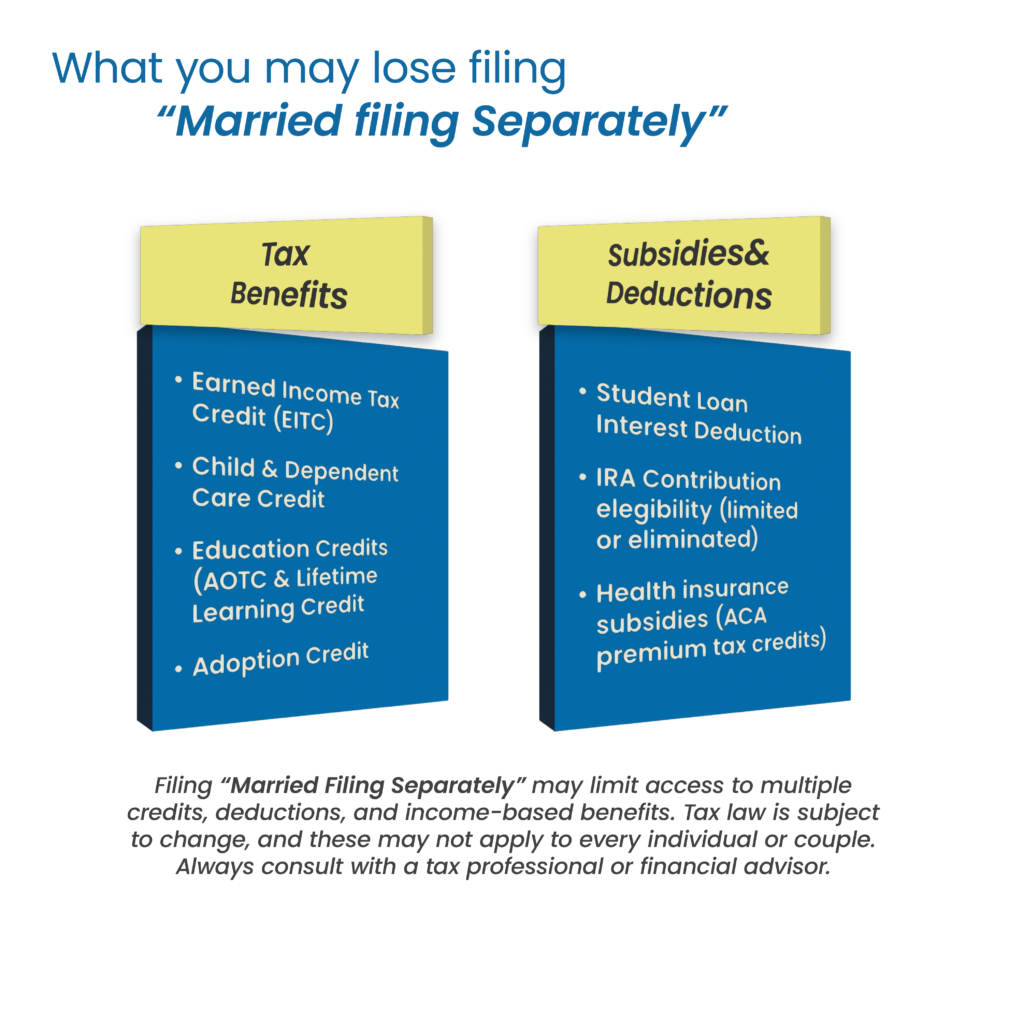
Filing separately may reduce your loan payment in certain cases, but it can also limit or eliminate access to certain tax benefits, like the student loan interest deduction (if otherwise eligible based on income limits) and other tax credits.
Federal vs. Private Loans: Why the Rules Are Different
Federal and private student loans operate under completely different systems.
Federal student loans are owned and managed by the U.S. Department of Education. They may offer:
- IDR plans that adjust payments based on income.
- The ability to change repayment plans, or temporarily pause payments due to hardship.
- Potential eligibility for forgiveness programs.
Private student loans are owned and managed by private lenders. They may offer:
- Eligibility-based refinancing with low or fixed interest rates.
- Custom repayment plans.
- In limited cases, hardship programs.
For borrowers with private student loans, tax filing status typically does not affect monthly payments. From a marriage standpoint, that means the overall strategy for private student loans is less about tax filing and more about whether to refinance to a lower or fixed interest rate. For more info on if and when you should refinance your student loan, check out our blog post on repayment options.
Common Myths About Marriage and Student Debt
There are a few common misconceptions about marriage and student loans that may cause unnecessary anxiety and confusion. Let’s address them.
“My spouse will be responsible for my student loans.”
- Loans stay with the person who borrowed them unless the spouse co-signed.
“Getting married will automatically increase my student loan payment.”
- Your payment may increase, decrease, or stay the same depending on your income, your spouse’s income, and how you file your taxes.
“I need to file separately to keep payments low.”
- Filing separately can reduce your loan payment but may increase your overall tax bill. It’s important to review your specific situation with a tax professional before making a decision.
“All student loans are basically the same.”
- They are not. Federal and private student loans operate under different rules and regulations.
The Tax Filing Decision: An Important Financial Choice
Once you’re married, how you file your taxes becomes a critical decision that needs to be discussed with your partner and either a financial or tax advisor.
The decision to either file “Married Filing Jointly” or “Married Filing Separately” can depend on your income, your spouse’s income, and the amount and the type of student loans (if you have any).
How Tax Filing Affects Your IDR Payments
On an IDR plan? Your tax filing is important.
| Married Filing Jointly | Married Filing Separately |
|---|---|
|
|
Same loans. Different impact.
Each filing comes with pros and cons, which is why you must review the total financial impact.
Married Filing Jointly: Using Combined Income
When you file your taxes jointly, you combine both incomes with a single tax return.
From a student loan perspective, that generally means your combined household income (which is used to calculate payments under an IDR plan) will increase.
At a high level:
- A higher combined income can mean a higher calculated payment for IDR plans.
- If both spouses have federal loans under IDR plans, the payment may be prorated based on respective balances.
While joint filing may increase a monthly loan payment, it could still result in an overall better financial performance. How?
Filing jointly can maintain eligibility for certain tax benefits and credits that could be lost if you file separately. This includes the Earned Income Tax Credit (EITC) and the Child and Dependent Care credit. In some cases, tax savings can outweigh the increase in a loan payment when looked at on an annual basis. Remember to review potential benefits, credits, and options with a financial advisor or a tax professional to get a clear picture of your particular situation.
Married Filing Separately: Using Only Your Income
If you file separately, you and your spouse will report income on separate tax returns. For certain IDR plans, this means your payment is based on only your income.
Filing separately may be advantageous if your partner earns significantly more than you do, or if they don’t have any loans. Why? It generally prevents their income from potentially increasing your payment under a household calculation method.
It’s important to note that filing separately may limit or eliminate eligibility for certain deductions and tax credits, potentially resulting in a higher tax bill. Couples should do the math and determine which costs more: a higher monthly loan payment or the overall tax bill.
Additionally, if you live in a community property state (like Arizona, California, or Texas), income may be split 50/50 for tax purposes, even if you file separately.
Real Examples: What the Numbers Actually Look Like
Tax filings can be confusing, so let’s look at an example:
Assume Spouse A earns $70K and has federal student loans on an IDR plan, while Spouse B earns $200K and does not.
- Filing jointly means a household income of $270K.
- Filing separately means a monthly payment based on $70K for Spouse A.
In this case, filing separately might be the better option. Spouse B’s higher income may increase the payment for Spouse A, even though Spouse B does not have any loans.
However, once you factor in the potential loss of tax benefits from filing separately, the outcome could shift. What looks like an obvious choice on the loan payment side might not be as strong when you look at the full financial picture.
How Tax Filing Impacts Spouse A
| Filing Separately | Filing Jointly | Notes | |
|---|---|---|---|
| Spouse A Income | $70,000 | $70,000 | Only Spouse A’s income is counted in a separate filing. |
| Spouse B Income | $200,000 | $200,000 | Spouse B’s income is counted in a joint filing. |
| Household Income for IDR | $70,000 | $270,000 | Household income impacts monthly payments for IDR plans. |
The Amendment Strategy You Need to Know
If needed, a couple can amend a tax return from “Married Filing Separately” to “Married Filing Jointly”. This does not generally work in reverse, however.
Some couples file separately first to keep payments lower, then amend later if filing jointly makes more financial sense. This is a lesser-known tax strategy, and it’s not something you should do without the guidance of a tax professional.
2026 Student Loan Changes Every Married Couple Should Know
Student loan rules and regulations are not static, and 2026 has already been a big year for changes from the Department of Education.
If you’re getting married or recently married, these changes could affect your repayment strategy.
The New RAP Plan: What’s Coming 1 July 2026
A new repayment plan, the Repayment Assistance Plan (RAP), is expected to launch on 1 July 2026.
Details are still being finalized, but the plan is expected to work as an income-based repayment plan, similar to existing IDR plans. As of March 2026, the plan’s treatment of spousal income and its impact on monthly payments are unclear.
Most, but not all, IDR plans allow a borrower to exclude their spouse’s income by filing taxes separately. However, the Income-Contingent Repayment (ICR) plan may still include it. Whether RAP will offer this exclusion is yet to be determined.
Legislative changes to student loans, including the creation of new plans, are subject to change.
PAYE and ICR Phase-Out Timeline
Two existing repayment plans, PAYE (Pay As You Earn) and ICR, may be phased out or limited in the future.
While rulemaking and legal challenges are ongoing, the current expectation is that new borrowers will not be able to enroll in PAYE or ICR on or after 1 July 2027, and borrowers enrolled in these plans may be transitioned to other plans by 1 July 2028.
For borrowers currently enrolled in these plans, now may be a good time to start considering other options.
Legislative Uncertainty and How to Plan Anyway
Student loan policy is actively changing.
Between new repayment plans, court rulings, phase-outs, and legislative proposals, it’s easy to feel overwhelmed by policy and procedures. So, what can you do?
Focus on what’s in your control:
- Understand how your current repayment plan works.
- Run scenarios based on filing jointly vs. separately.
- Review your tax and student loan strategy every year, especially if your income or your overall household income changes.
Focus on your plan and your monthly payment, and watch for alerts that directly affect either.
Private Student Loans: A Different Strategy for Married Couples
There is a big difference between federal student loans and private student loans. Private loans do not follow the same rules and regulations as federal loans, and that affects how you plan for them as a couple.
Why Private Loans Don’t Play by Federal Rules
Private loans follow the loan servicer’s terms agreed upon at loan origination (when the loan started). Private loans are not eligible for federal IDR programs, federal forgiveness programs, or federal student loan protections.
This means:
- Your tax filing status does not impact your private loan payment.
- Strategies like filing separately to reduce payments do not apply.
- Your monthly payment generally remains the same unless your loan has a variable interest rate or if you refinance.
For married couples with private loans, it may be beneficial to focus more on interest rates, loan terms, and household cash flow.
Refinancing Options Before and After Marriage
Refinancing private loans can look very different depending on whether you do it before or after getting married.
Before marriage:
- You’re applying individually, so only your credit score and income matter.
- Your spouse’s income or debt won’t affect approval.
After marriage:
- You can apply together as co-borrowers, combining incomes to potentially qualify for a better rate or terms.
- Both spouses’ credit scores and employment are considered, which can help or hurt approval.
- Co-borrowing ties both spouses legally to the debt, so it’s important to be comfortable sharing responsibility.
How Yrefy Helps Couples with Distressed Private Loans
Delinquent or defaulted private student loans can cause serious stress for couples trying to build a life together. Distressed student loan debt can hamper life goals like buying a home, starting a family, or simply achieving financial peace of mind.
Yrefy specializes in helping borrowers with defaulted or delinquent private student loans, even those with bad credit scores. With fixed rates from 1% to 5.99% for eligible borrowers, Yrefy has helped thousands of borrowers refinance their private student loans.
If private loans are causing financial concerns, it may be worth exploring your options.
When Refinancing Together Makes Sense
Refinancing as a couple can be a smart move, but it should be reviewed carefully before any decision is made.
Refinancing as a couple may make sense if you want to combine multiple loans into one payment or lower your interest rate. Applying together can also help couples qualify for better terms if both spouses have stable incomes and solid credit histories.
That said, co-borrowing also ties both spouses legally to the debt. If one spouse has weaker credit or unstable income, refinancing together could make approval harder or increase the interest rate. If either spouse wants to preserve federal loan protections, such as income-driven repayment or eligibility for forgiveness, refinancing federal loans is not recommended.
Refinancing private student loans may offer benefits, but the decision should be made with full awareness of the joint obligation to repay the debt.
Three-Step Decision Framework
At this point, you may be wondering, “How do I decide whether to file jointly or separately?” Let’s break this into three easy steps:
Step 1: Calculate Your Tax Input
Start with your taxes and run your return both ways:
- Married Filing Jointly
- Married Filing Separately
You can use tax software, AI-based tools for rough estimates, or work with a tax professional to estimate both outcomes.
Focus on the difference in your total tax bill. This should include not just what you owe, but also what you may lose by filing separately (like credits, deductions, and other tax benefits).
At the end of this step, write down the answer to the following question:
- How much more (or less) do you pay in taxes under each option?
Step 2: Calculate Your Loan Payment Impact
Then estimate what your student loan payment would look like under two scenarios:
- What your payment looks like if you file jointly.
- What your payment looks like if you file separately.
If you’re on an IDR plan, remember that:
- Filing jointly may use your combined household income.
- Filing separately may allow you to use just your income.
At the end of this step, write down the answer to the following question:
- How much does the monthly payment actually change?
Step 3: Find Your Household’s Optimal Strategy
Compare the change in your tax bill with the change in your student loan payment.
If filing jointly increases your payment but saves more in taxes, it may still be the better choice. If filing separately lowers your payment more than it increases your taxes, that may be the better decision.
There’s no universal answer here; what works best will be different for each couple.
Having “The Talk”: Money Conversations with Your Partner
Talking about finances can feel very awkward at first, but it’s also an opportunity to bond over a sensitive topic and grow as a couple.
Questions Every Couple Should Ask Each Other
Consider asking:
- What do we owe?
- What do we earn?
- What are we working toward financially?
This conversation should include a review of loan balances, income, and savings goals.
Create a Shared Student Loan Strategy
Once all information is on the table, decide how you’ll approach repayment as a team. Remember it’s: “us against the debt”. This might mean prioritizing lower monthly payments, paying off loans faster, or optimizing tax planning.
When to Bring in Professional Help
If the numbers get complicated or confusing, get help before making a decision.
A tax professional or a financial planner can help you avoid expensive mistakes, especially if you’re dealing with large balances or delinquent loans.
Mistakes to Avoid
Even financially savvy couples can make mistakes. Here are a few common pitfalls to avoid:
- Filing jointly without running the numbers.
- Ignoring IDR recertification when income changes.
- Refinancing federal loans without considering the loss of federal protections.
Avoiding these common mistakes can reduce stress as you navigate finances with your spouse.
Special Situations: When Standard Advice Doesn’t Apply
Not every couple fits the typical scenario.
For example, if a couple is pursuing Public Service Loan Forgiveness (PSLF), refinancing federal loans will eliminate that eligibility. For couples in the military, deployment-related protections can also affect repayment.
If you have a unique situation involving a second marriage, community property states, high-income households, or even working while your spouse is in school, talk with an expert.
Your Action Plan: Next Steps Based on Where You Are
We want to say: congratulations!
You are starting a new chapter of life, and planning to address your student loan debt with your partner is a good step toward a strong financial future.
If private student loans are preventing you from achieving joint financial goals, whether it’s buying a home, starting a family, or just having peace of mind, Yrefy can help. We work with couples that traditional lenders won’t, because we know that financial setbacks happen.
Get in touch with us at (888) 358-3359, or fill out our contact form, and a member of our team will reach out to you.
Disclaimer: This article is for informational purposes only and should not be considered legal, tax, or financial advice. Tax laws are complex and change frequently. Please consult with a qualified tax professional or financial advisor regarding your specific situation before making filing decisions.