
Student Loans and Credit Cards: How to Manage Both

Table of Contents
The Reality of Managing Multiple Types of Debt
For many borrowers, student loan and credit card debt coexist. Between multiple due dates, interest costs, and the pressure to make progress, it can start to feel like you are treading water financially.
If you have both credit card and student loan debt, you’re not alone. This is common, especially for borrowers in their 20s, 30s, and 40s who are balancing everyday expenses with debt payments.
Student loans and credit cards behave very differently, and understanding how they behave is the first step towards building a debt management strategy that works for you.
This guide explains how each type of debt works, how to prioritize payments, and how to create a plan to take control of your debt.
Understanding Student Loans and Credit Card Basics
Student loans and credit cards differ in how they are structured, how interest accrues, and how they are repaid.
Types of Student Loans: Federal vs. Private
Student loans generally fall into two categories: federal and private.
Federal student loans are issued by the U.S. Department of Education and come with built-in protections. These include access to Income-Driven Repayment (IDR) Plans, potential forgiveness programs, and options such as deferment or forbearance during periods of financial hardship. For borrowers experiencing changes in income or employment, these protections can provide meaningful flexibility and help prevent delinquency or default.
Private student loans, on the other hand, are issued by banks, credit unions, or other private lenders. They do not offer federal repayment programs or forgiveness options. While some lenders may provide temporary hardship assistance, such as interest-only payments or short-term modifications, these options vary by lender and may not be available. Terms are often fixed at origination, leaving borrowers with fewer options if their financial situation changes unexpectedly.
If you have both types of loans, it is important to evaluate them separately. Federal loans may offer structured flexibility, while private loans typically require a more direct repayment or refinancing strategy.
Overview of Credit Card Features and Fees
Credit cards are a form of revolving debt — your balance can change month to month depending on how much you spend and repay.
Unlike student loans, credit cards may have:
- Variable interest rates that can change over time.
- Minimum payment requirements that may not significantly reduce the principal balance.
- Additional costs such as late fees, annual fees, and penalty interest rates.
One of the most important characteristics of credit cards is that they allow ongoing borrowing. While this provides short-term financial flexibility, it also creates a risk of long-term balance growth if spending is not carefully managed. Even when minimum payments are made on time, balances can remain high for extended periods due to daily compounding interest.
Comparing Student Loan and Credit Card Interest Rates
Credit cards typically carry significantly higher interest rates than student loans, making them one of the most expensive forms of consumer debt.
Credit card Annual Percentage Rates (APRs) often fall in the mid-to-high double digits and, in some cases, may exceed that range.
Federal student loan rates are generally lower and fixed, often falling in the low-to-mid single digits depending on the loan type and the year it was issued.
Private student loan rates vary by creditworthiness but are often lower than credit card rates for qualified borrowers.
This difference in interest rates matters because it directly impacts how quickly debt grows over time and how much each payment reduces the principal balance.
The Impact of Interest Rates and Fees
Interest is not just a number. It directly affects how long it takes to become debt-free and how much you ultimately will repay.
With credit card debt, high interest rates often mean that a large portion of each monthly payment goes toward interest rather than reducing the principal. As a result, progress toward debt freedom can feel slow even when consistent payments are being made, especially if new purchases are consistently added to the balance.
Credit Card vs. Student Loan Interest Rate Ranges
| Debt Type | Typical Interest Rate Range | Key Characteristics |
|---|---|---|
| Credit Cards | 15% – 30%+ APR | Variable rates with compound interest; balances can grow quickly even with minimum payments. |
| Federal Student Loans | 4% – 9% | Fixed rates with structured repayment plans and access to federal protections like income-driven repayment. |
| Private Student Loans | 5% – 15%+ | Rates vary based on creditworthiness; fewer repayment protections and terms by lender., |
These interest rates are general estimates and may vary based on credit profiles, lender, loan type, and market conditions.
Student loans, particularly federal loans, tend to be more predictable. Fixed interest rates and structured repayment plans make it easier to forecast long-term repayment and understand how balances will decline over time.
Credit card debt typically grows faster and costs more to carry, while student loans tend to offer structured and stable repayment options. Understanding this distinction is essential when deciding where to allocate additional payments and how to structure your overall debt strategy.
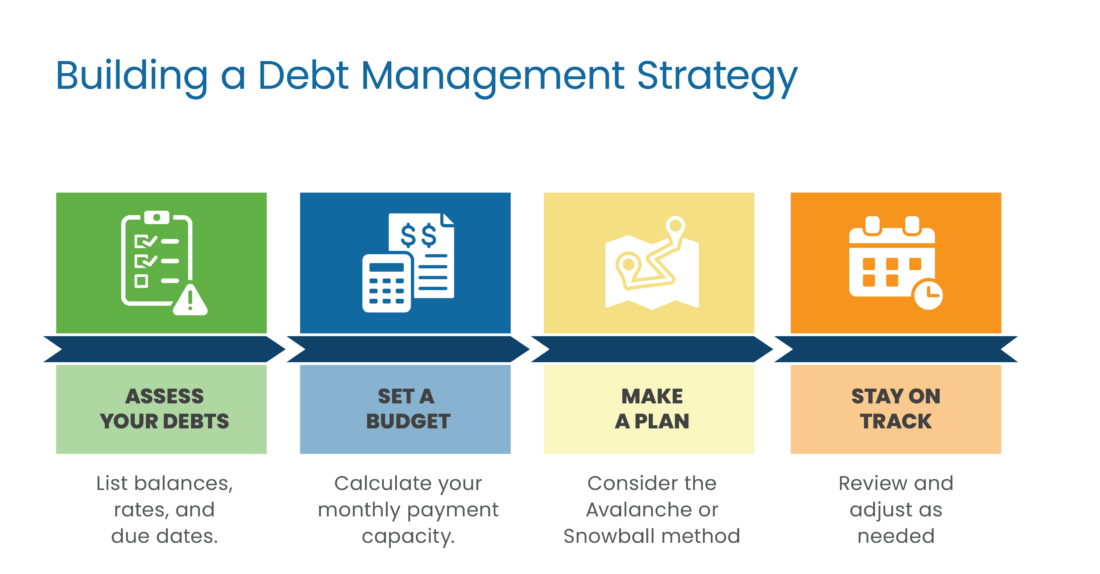
Building a Debt Management Strategy
Without a clear strategy, it can be easy to feel “stuck” or unsure where to focus repayment efforts, especially when multiple balances compete for attention each month.
A workable debt management strategy does not rely on estimations. Rather, it’s built on full awareness of your financial situation. Though it may feel uncomfortable, the debt must be confronted and analyzed.
Assessing Your Balances and Accounts for Payments
Start by getting a clear picture of your current finances.
List out each student loan and credit card (and other debts) along with their current balance, interest rate, minimum monthly payment, and due date. For student loans, also identify whether each loan is federal or private.
When everything is visible in one place, it becomes easier to identify which debts are costing the most and where adjustments can have the greatest impact.
Budgeting for Payments
At a minimum, your plan should consistently cover all required payments for both student loans and credit cards. Missing payments can lead to late fees, a damaged credit score, and, in the case of credit cards, higher penalty interest rates.
Once essentials are covered, focus on understanding what flexibility you have each month. This means reviewing your income after essential expenses and identifying a realistic amount to allocate to additional payments. That number does not need to be excessively large to be effective, but it needs to be consistent.
Overcommitting or pushing your budget to the limit can backfire. If every dollar is committed, even a small, unexpected expense can force you back onto credit cards, slowing progress and increasing overall costs.
Creating a Repayment Plan
There are two common approaches to paying down multiple debts: the avalanche method and the snowball method.
- The avalanche method focuses on paying off the highest-interest debt first while maintaining minimum payments on others. This approach minimizes total interest paid.
- The snowball method focuses on paying off the smallest balance first to build momentum and motivation.
For borrowers managing both student loans and credit card debt, the avalanche method often provides the greatest financial benefit. Because credit cards typically carry higher interest rates, directing extra payments toward those balances can reduce total interest costs more quickly. However, the snowball method can provide “quick wins” that alleviate mental pressure and drive progress toward resolving the next debt. Let’s look at an example with mock numbers.
- Assume Borrower A has the following debt (annual interest rates):
- Credit card: $5,000 at 20% interest.
- Student loan: $10,000 at 5% interest.
- Personal loan: $500 at 8% interest.
| Method | Payoff Order | Total Interest | Key Benefit |
|---|---|---|---|
| Avalanche | Credit Card → Personal Loan → Student Loan | $1,500 | Targets highest-interest debt first, reducing the total cost. |
| Snowball | Personal Loan → Credit Card → Student Loan | $1,800 | Provides a quick early win by paying off the smallest debt first (personal loan). |
Illustrative example for comparison purposes only. Actual interest costs and timelines vary based on balances, rates, and repayment behavior.
The best plan is the one you can stick with consistently.
Optimizing Student Loan Repayment
When managing both student loan and credit card debt, your repayment strategy should align with your larger goals. The way you structure your student loan payments can directly affect how much flexibility you have to reduce high-interest credit card balances.
Exploring Repayment Plans
Federal loans offer different repayment plans designed to adjust to a borrower’s financial situation. These include:
- The Standard Repayment Plan offers fixed payments over a set period, which can help borrowers who want predictability and a clear payoff timeline.
- Income-Driven Repayment Plans adjust monthly payments based on income and household size. For borrowers balancing credit card debt, this can create additional breathing room in the budget by lowering required loan payments. That flexibility can then be redirected toward higher-interest debt.
Private student loans operate differently. Terms are typically fixed at origination, and flexibility depends on the lender rather than federal programs. Some lenders offer temporary hardship options, such as modified payments or short-term relief, but these are not guaranteed and often require direct communication with the lender.
Federal repayment plans and programs are actively changing due to federal policy updates and legal action. To stay up to date on alerts, please check the alerts banner at the top of Studentaid.gov.
Loan Forgiveness and Assistance
Some federal student loan borrowers may qualify for forgiveness or repayment assistance programs based on their employment, repayment history, and other criteria.
- Programs such as Public Service Loan Forgiveness (PSLF) are designed for individuals working in qualifying nonprofit or government roles, where remaining balances may be forgiven after meeting specific requirements.
- Income-Driven Repayment Plans may also offer a pathway for forgiveness after 20-25 years of qualifying payments. However, in some cases, the forgiven amount may be taxable. These programs can significantly reduce long-term costs but require careful planning and consistent documentation.
- In some cases, borrowers who are totally and permanently disabled may qualify for a discharge of their federal loans (requirements apply). Additionally, some borrowers may qualify for a discharge of federal loans due to their school’s actions, such as school closure or proven misconduct that affected the borrower’s ability to complete their program or receive the expected educational value.
Private student loans do not qualify for federal forgiveness. For these loans, relief options are typically limited to refinancing, modified repayment programs, or, in rare cases, a settlement, depending on the lender and account status.
For a full list of federal loan forgiveness and discharge options, please read the Student Loan Forgiveness page on studentaid.gov. For more information on loan forgiveness, please read this article on the Yrefy blog. We also have articles covering both federal loan settlement and private loan settlement.
Consolidation and Refinancing
Consolidation and refinancing can simplify repayment, but they serve different purposes.
Federal loan consolidation combines multiple loans into a single loan with a single payment. While this can make repayment easier to manage, it does not generally reduce interest rates and may extend the repayment timeline.
Refinancing replaces an existing loan with a new one, typically via a private lender. This can result in a lower interest rate or more favorable terms for qualified borrowers, though rates vary. Refinancing federal loans into private loans removes access to federal protections, including income-driven repayment and forgiveness programs.
For borrowers with both student loans and credit card debt, refinancing decisions should be made carefully. Lowering a monthly payment can free up cash flow, but it is important to weigh that benefit against the loss of flexibility. To learn more about refinancing, please check out this complete guide on the Yrefy blog.
Using Grace Periods Effectively
Federal loans often include grace periods or temporary relief options, such as deferment or forbearance. These tools can provide short-term support during financial transitions, but they may result in growing balances.
Interest may continue to accrue during these periods, particularly for unsubsidized loans, which can increase the total cost over time. For that reason, they should be viewed as temporary solutions rather than long-term strategies.
Private loan relief options may exist, but are typically more limited and vary by lender.
Managing Credit Cards Alongside Student Loans
Credit cards are often the most immediate pressure point in a debt management strategy. Unlike student loans, their higher interest rates can cause balances to grow, even when you are making regular payments.
Smart Credit Card Use
If you have a credit card balance, limiting new charges is one of the most effective ways to prevent further debt.
This doesn’t mean eliminating credit card use entirely, but it does mean watching your spending. Reducing non-essential spending and avoiding reliance on credit for recurring expenses (like entertainment subscriptions) can stabilize your balances while you work on repayment.
Without this step, even strong repayment efforts can be offset by new charges.
Strategies for Reducing Credit Card Debt
Because credit cards typically have high interest rates, they are often the first place to focus extra payments on.
Paying more than the minimum each month should be considered. Minimum payments are designed to keep accounts in good standing, not necessarily to reduce balances quickly. In many cases, a large portion of the minimum payment may go toward interest, leaving only a small amount to reduce principal, which slows progress toward debt repayment.
Directing additional funds toward the highest-interest cards first can help reduce total borrowing costs over time. For some, a balance transfer may be worth exploring if it offers a meaningful reduction in interest, though fees, terms, and the expiration of promotional rates should be carefully reviewed.
Where to Start When You Have Student Loans and Credit Card Debt:
| Do you have credit card debt? | Do you have student loans? |
|---|---|
| → YES: Consider directing extra payments towards high-interest credit cards first. | → YES: Optimize repayment strategy:
|
| → NO: Focus on the student loans. | → NO: Focus on the credit card debt. |
For informational purposes only. Repayment options based on loan type, lender, and eligibility.
Credit Card Impacts on Loan Repayment
High credit card balances can affect your credit profile, which may impact your ability to refinance loans or qualify for more favorable financial terms in the future. As balances decrease and payment history improves, borrowers may gain access to better options.
Consolidating and Refinancing Debt
When managing multiple forms of debt, consolidation or refinancing may seem like a straightforward solution. In practice, these tools can be helpful, but they are not always the right fit for every borrower.
Pros and Cons of Loan Consolidation
At a basic level, consolidation combines multiple balances into a single loan with one monthly payment. This can make repayment easier to manage and reduce the likelihood of missed or late payments.
For federal loans, consolidation is primarily an organizational tool. It simplifies repayment but does not lower your interest rate. Instead, the new rate is a weighted average of your existing loans. In some cases, extending the repayment term can lower your monthly payment, but it may also increase the total interest paid over time.
For credit cards, consolidation often takes the form of a personal loan or balance transfer. If the new interest rate is meaningfully lower, it can accelerate payoffs and reduce the total cost. However, these options are dependent on your credit profile, and promotional rates may be temporary.
Consolidation can be helpful, but it is not inherently a cost-saving strategy. Its value depends on whether it reduces interest, improves cash flow, or simply makes repayment more manageable.
Balancing Credit Card and Student Loan Consolidation
Student loans and credit cards serve different roles, which is why combining them into a single repayment strategy requires careful consideration.
Student loans, particularly federal loans, often provide structured repayment options and built-in protections. Credit cards, by contrast, are higher-cost and more flexible with monthly repayment amounts, which makes credit card debt easier to accumulate and generally more expensive to carry over time.
Because of this, many benefit from keeping these debts separate and addressing them with different strategies. For example, maintaining flexible repayment terms on federal loans while aggressively paying down high-interest cards can reduce total borrowing costs more efficiently than combining everything into a single loan.
Long-Term Financial Health and Resources
Debt management is about repayment, monitoring your credit score, tracking balances, and protecting your credit report from inaccuracies.
Monitoring Your Credit
Checking your credit report regularly can help you track your progress, spot issues, and understand how your debt affects your overall financial profile.
Under federal law, you are entitled to access your credit reports for free from each of the three major credit bureaus through AnnualCreditReport.com. The three major credit bureaus are:
Consistent monitoring is especially important when managing multiple debt types. Over time, improvements in your credit may also open the door to better refinancing or financial options. Many credit cards and other financial tools (discussed in detail below) may also provide access to credit score tracking through mobile apps and online accounts.
Seeking Professional Guidance
If your situation feels complex or overwhelming, it may help to speak with a professional.
Financial advisors, credit counselors, and student loan specialists can help you evaluate your options and build a plan tailored to your specific circumstances. This can be especially helpful for borrowers managing multiple types of debt or navigating default situations.
Leveraging Online Tools and Government Resources
Several trusted resources can help you stay informed and make more confident financial decisions using both government and consumer financial tools:
- Federal Student Aid for federal loan repayment and forgiveness information, and student loan repayment simulators.
- Consumer Financial Protection Bureau for guidance on credit cards and debt management tools.
- Internal Revenue Service and Federal Student Aid for student loan interest deduction and tax details.
- Consumer financial tools and apps (such as Monarch or CreditKarma) for budgeting, credit monitoring, and tracking debt and spending.
Using reliable sources helps ensure that your strategy is based on accurate, up-to-date information.
Final Considerations
Millions of Americans have credit card debt, student loan debt, or both. You are not alone. By confronting your balances, building a debt strategy, and staying consistent, you can make repayment more manageable.
If you are struggling with delinquent or defaulted private student loans, Yrefy can help. Yrefy works with borrowers who may not qualify for traditional refinancing from other lenders. Yes, even those with bad credit.
Want to learn more? Get in touch with us at (888) 358-3359, or fill out our contact form, and a member of our team will reach out to you.
Disclaimer: This article is for informational purposes only and should not be considered legal, tax, or financial advice. Tax laws are complex and change frequently. Please consult with a qualified tax professional or financial advisor regarding your specific situation before making tax filing or other financial decisions.