
Student Loans and 401(k)s: Should You Pay Debt or Invest?

Table of Contents
Balancing Debt and Your Future
While repaying student loans, the idea of retirement can feel far away. At the same time, ignoring your financial future is not a long-term strategy.
That’s when balancing can feel difficult: should you focus on paying down your loans as quickly as possible, or start investing in your 401(k)?
There isn’t a single answer that works for everyone. The right approach depends on a mix of factors, including interest rates, employer benefits, financial stability, and long-term goals.
This guide breaks down some key considerations to help you balance loan repayment with investing for your future.
Student Loans Payoff or 401(k) Investment: Key Considerations
Deciding whether to prioritize student loan repayment or retirement savings often comes down to short-term financial pressure versus long-term financial goals.
Comparing Student Loan Interest Rates and Investment Returns
One of the most practical ways to evaluate whether to invest or pay off debt is to compare the cost of the debt to the potential return on investment.
Student loan interest, particularly with private loans, represents a guaranteed cost, or a cost that will persist and possibly grow until the loan is resolved. How? Student loans accrue interest over time based on the remaining balance and the interest rate. This means that unless payments exceed the interest being charged, your balance may grow.
Let’s look at a visual example:
| Scenario | Interest | Payment | Result |
|---|---|---|---|
| Payment is LESS than interest | $75 | $50 | Balance increases |
| Payment EQUALS interest | $75 | $75 | Balance stays flat |
| Payment is MORE than interest | $75 | $100 | Balance decreases |
In contrast, returns on investments are not guaranteed. While long-term market performance has historically averaged in the mid-to-high single digits, returns can vary significantly from year to year.
Debt often functions as a “guaranteed return” when paid off, since eliminating it prevents further interest from accruing. However, lower-interest debt may make investing more attractive, particularly over longer time horizons where compounding interest has more time to work.
At a high level, this cost-versus-return comparison is the starting point for evaluating both options.
Risk Tolerance and Time Horizon
Personal risk tolerance and time horizon play an important role in how to approach this decision.
Investing in a 401(k) involves exposure to market volatility and financial risk. Account values fluctuate over time, and short-term declines are a normal part of market cycles. While volatility is generally accepted as part of long-term investing, it can feel difficult to manage when financial pressure is already high due to debt.
Time horizon also matters, as retirement accounts are designed for long-term growth, often over several decades. A longer timeline allows investments more opportunity to recover from downturns and benefit from compounding growth over time.
Student loans, in contrast, have a defined repayment structure. Monthly obligations are generally consistent, but carrying balances over extended periods increases the total interest paid over the life of the loan.
Impact on Financial Goals
Debt repayment and retirement savings are not isolated choices; both directly influence overall financial stability, cash flow, and long-term wealth building.
For those prioritizing reducing monthly financial pressure, focusing on debt repayment may provide more immediate benefits. While monthly payments are often fixed, reducing balances can shorten the repayment timeline and lower total interest costs, which could improve financial flexibility over time.
For those focused on long-term growth, consistent retirement contributions are a key driver of future financial security. Even relatively small, steady contributions can grow significantly over time due to compounding interest.
Shifts in income, debt levels, and financial priorities can change how these trade-offs are weighed.
High Interest Debt Payoff vs. 401(k) Match: Key Differences
| High-Interest Debt Payoff | 401(k) Match | |
|---|---|---|
| Type of Return | Guaranteed savings (interest avoided) | Immediate gain via employer contribution (subject to vesting) |
| Risk Level | No market risk, but money use to paydown debt isn’t invested | Market risk |
| Impact Over Time | Reduces total interest costs | Investments may grow with compounding |
Illustrative example of comparison purposes only.
Understanding Your Student Loan Types and Repayment Options
Before deciding how to balance debt repayment with retirement savings, it is important to understand how different types of student loans function. Federal and private loans follow different rules, offer different protections, and provide different levels of flexibility.
Federal vs. Private Student Loans
Federal student loans are issued by the U.S. Department of Education and are designed with built-in flexibility. Borrowers may have access to Income-Driven Repayment (IDR) Plans, potential forgiveness programs, and deferment or forbearance options during periods of financial hardship. These features can make it easier to adjust payments when income changes or financial priorities shift.
Private student loans are issued by banks, credit unions, and other lenders, and generally follow fixed terms. They do not offer federal repayment programs or forgiveness options. While some lenders may provide temporary relief, such as modified payment plans, these options vary and are not guaranteed. In most cases, repayment terms are established at origination and offer less flexibility over time.
Because of these differences, federal and private loans are often approached differently. Federal loans may offer more repayment flexibility, while private loans often require a more direct repayment strategy or refinancing.
Want to learn more about loan types and repayment options? Check out this article on our blog, which covers both federal and private loans.
Income-Driven Repayment Plans and Forgiveness Programs
For borrowers with federal student loans, Income-Driven Repayment (IDR) Plans can significantly reduce monthly payments.
- IDR plans adjust monthly payment amounts based on income and household size, which can make payments more manageable during periods of lower earnings. In some cases, this can free up cash to address debt, including higher-interest debt.
Federal loans may also offer forgiveness options under specific conditions.
- Programs such as Public Service Loan Forgiveness (PSLF) are designed for borrowers working in qualifying public service roles, where remaining balances may be forgiven after meeting program requirements.
- IDR plans may provide a path to forgiveness after a set repayment period, typically 20 to 25 years, though tax implications may apply.
Private student loans do not offer these types of forgiveness programs. Repayment options are generally limited to the terms agreed upon with the lender, which may include standard repayment schedules or lender-specific modifications in certain situations.
Minimum Payments and Repayment Strategies
While minimum payments keep loans current, they are not designed to reduce debt efficiently. For many loans, especially those with longer terms, a large portion of each payment may initially go toward interest, slowing the repayment of the principal balance.
How Minimum Payments Can Grow a Debt Balance
(assumes a minimum payment of $50)
| Month | Starting Balance | Interest (9% APR) | Payment | Ending Balance |
|---|---|---|---|---|
| 1 | $10,000 | $75 | $50 | $10,025 |
| 2 | $10,025 | $75.19 | $50 | $10,050.19 |
| 3 | $10,050.19 | $75.38 | $50 | $10,075.75 |
This becomes more relevant when balancing debt repayment with retirement savings. Relying solely on minimum payments can extend the life of a loan and increase the total cost over time, potentially limiting the ability to redirect cash flow toward other goals (such as savings or paying off high-interest debt).
As a result, the repayment strategy plays an important role. In practice, repayment is rarely all-or-nothing. Many borrowers maintain minimum payments across all loans while directing additional funds where they will have the greatest financial impact. This can include:
- Prioritizing higher-interest debt to reduce overall interest costs.
- Targeting smaller balances first to build momentum as accounts are paid off.
- Maintaining minimum payments while gradually increasing retirement contributions.
No single approach is the “best”. The appropriate strategy depends on factors such as interest rates, loan types, repayment terms, and overall financial priorities.
Maximizing Retirement Savings and Employer Benefits
Retirement savings play an important role in long-term financial stability, but how and when to contribute can depend on existing debt obligations.
Understanding 401(k) Match and IRA Options
One of the most significant advantages of a 401(k) is the potential for employer matching contributions. Many employers match a portion of employee contributions up to a set percentage of salary. For example:
- An employee contributes 6% of their pay to a 401(k).
- Their employer matches contributions up to 6%.
In this example, the total contribution is 12% of pay, with half from the employer.
Because employer matching is so valuable, contributing enough to receive the full employer match is often prioritized. Employer contributions are generally considered part of total compensation, and not capturing the full amount could mean leaving money unclaimed.
Individual Retirement Accounts (IRAs) provide an additional option for retirement savings. There are many types of IRAs, including but not limited to:
- Traditional IRA: A tax-advantaged personal savings plan. Contributions may be tax-deductible, and earnings grow tax-deferred until withdrawal.
- Roth IRA: Another tax-advantaged personal savings plan. Contributions are made with after-tax income, but qualified withdrawals are generally tax-free.
- Simplified Employee Pension (SEP) IRA: Typically used by self-employed individuals or small business owners, with contributions made by the employer for each employee.
- Savings Incentive Match Plan (SIMPLE) IRA: Designed for small businesses, this plan allows both employee contributions and employer matching or nonelective contributions.
Each type of IRA has different tax treatment, contribution rules, and eligibility requirements, which can affect how retirement savings are structured alongside debt repayment. To learn more about IRAs, please visit this page on IRS.gov
The Power of Compound Interest
Compound interest is one of the primary drivers of long-term investment growth. Earnings generated within a retirement account can be reinvested, allowing future returns to build on both the original contributions and prior gains.
Time plays a critical role in this process. For example:
- Contributing $300 per month starting at age 25, assuming a 7% average annual return, could grow to approximately $720,000 by age 65.
- Waiting until age 35 to contribute the same $300 per month at the same return could grow to approximately $340,000 by age 65.
The difference is driven largely by time in the market rather than contribution size.
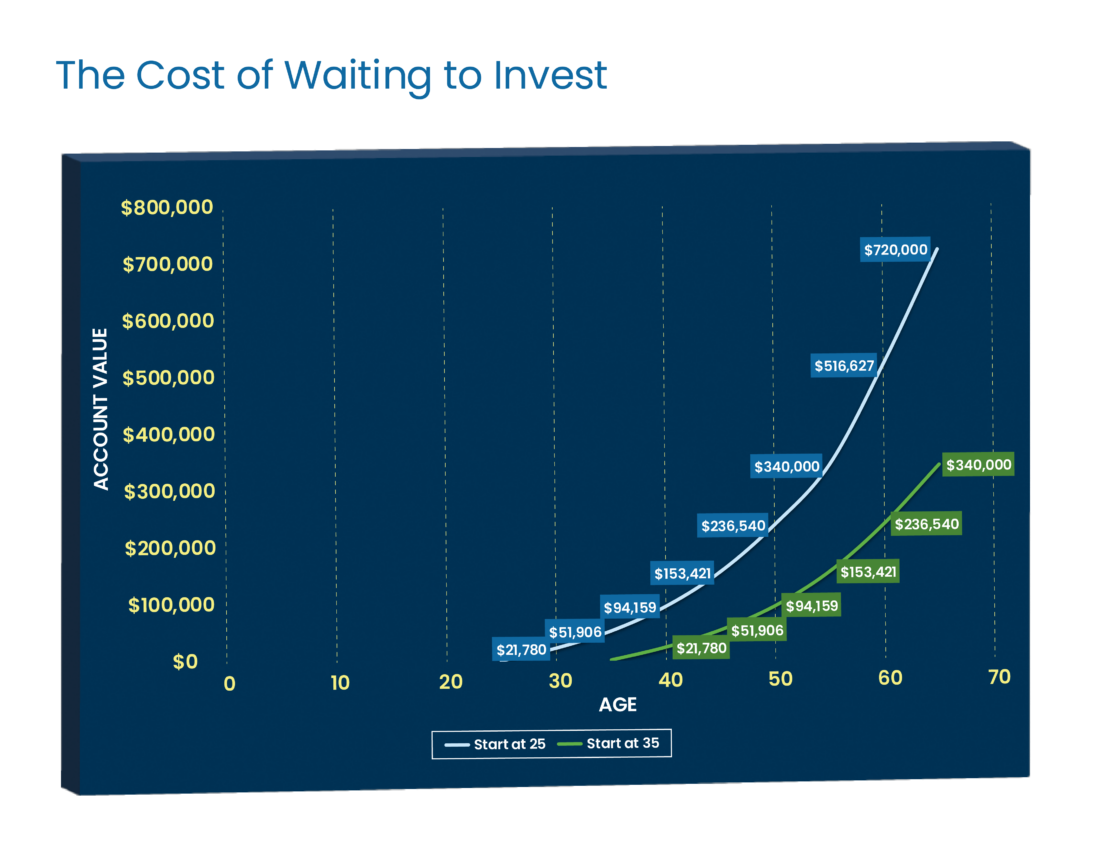
This dynamic is important when compared to student loan repayment. While paying down debt reduces a known cost, investing introduces the potential for long-term growth.
The key point to remember: Delaying contributions may reduce the total time available for compounding gains.
Balancing Retirement Contributions with Debt Repayment
Balancing debt repayment with retirement contributions often involves allocating limited financial resources across competing priorities.
One common approach is to separate priorities into two areas:
- Capture employer match first: Contributing enough to receive the full 401(k) match secures an immediate return on contributions.
- Address high-interest debt: Loans with higher interest rates may be prioritized for additional payments.
Consider the following example:
Assume Borrower B has a $20,000 private student loan at 9% interest and access to a 401(k) match of 5%:
- Contributing at least 5% captures the employer match.
- Additional funds directed toward the 9% loan reduces a guaranteed cost.
- After the balance decreases, contributions to retirement can be increased.
In practice, this approach allows progress in both areas without fully delaying either goal. The balance may shift as debt is reduced, income changes, or financial priorities evolve.
Creating a Personal Financial Strategy
Balancing student loan repayment with retirement savings ultimately depends on personal financial goals and current circumstances.
Establishing an Emergency Fund
Before increasing debt payments or retirement contributions, establishing an emergency fund is highly recommended.
An emergency fund is a cash reserve established for unplanned expenses. These expenses can include medical bills, car repairs, or temporary income loss.
Without a buffer, these costs may be added to credit card bills or other high-interest debt.
A common framework includes:
- $1,000 to $2,000 as an initial emergency reserve.
- 3 to 6 months of essential expenses for longer-term stability.
Even a modest emergency fund can help provide financial security and reduce reliance on high-interest debt.
Debt-to-Income Ratio and Cash Flow
Debt-to-income ratio (DTI) and cash flow are two separate indicators of financial stability. Knowing your DTI and cash flow metrics will help you build your personal financial strategy.
DTI is the percentage of gross monthly income (meaning before taxes) that goes toward debt payments. This debt can include payments toward student loans, credit cards, or even auto loans. While benchmarks vary, a DTI above 36% is generally considered elevated.
Cash flow is the amount of income remaining after essential expenses and required payments. Positive cash flow allows for additional debt repayment or increased retirement contributions, while negative or limited cash flow may require prioritizing stability first.
Tax Implications and Benefits
Traditional 401(k) and IRA contributions are typically made with pre-tax income, which may reduce taxable income in the current tax filing year. Roth IRA contributions are made with after-tax income, but allow for tax-free withdrawals in retirement, subject to eligibility requirements.
Student loan interest may also provide a tax benefit. In some cases, borrowers may deduct up to $2,500 in qualified student loan interest annually, depending on income limits and filing status.
Taxes are complex, and major tax decisions should be reviewed with a qualified tax professional or financial advisor before making changes.
Making the Decision: Pay Off Student Loans, Invest, or Both?
At the end of the day, this decision is less about finding a perfect formula and more about choosing a direction that fits your life and finances.
Sequential vs. Simultaneous Approach
So, which path is the best?
The answer is: it depends entirely on the person.
Some people prefer to focus on one priority at a time, while others choose to move both forward together — what matters is consistency.
Understanding Debt and Retirement Trade-Offs
Many financial strategies involve managing both at the same time.
| Student Loan Debt | 401(k) Contributions with Employer Match |
|---|---|
|
|
Emotional Factors and Peace of Mind
Financial decisions are not purely about numbers and monthly statements. The emotional weight of debt is real, and it can be significant. For some borrowers, eliminating student loans provides a sense of relief that outweighs potential investment gains.
Others may feel more secure knowing they are actively building toward retirement, even if debt remains. There is no “correct” emotional response. Recognize how your financial choices impact your stress levels, and make a plan that is financially savvy and emotionally safe.
When to Consult a Financial Advisor
If you are unsure how, or whether, to balance debt payments versus retirement savings, a financial advisor can help you evaluate your options in the context of your full financial picture.
This is especially valuable if you have a mix of loan types, fluctuating income, or other goals like homeownership or early retirement. When in doubt, consult a qualified financial advisor and/or a tax professional.
Next Steps and Final Considerations
Student loan debt and retirement savings do not have to be mutually exclusive.
The key is determining how to balance both effectively. While managing debt and saving for the future can feel overwhelming, steady progress over time can lead to meaningful financial stability.
If defaulted or distressed private student loans are impacting your financial future, Yrefy may be able to help. Yrefy works with borrowers who may not qualify for refinancing through other lenders, including those with bad credit.
Check out our real testimonials, and if interested, contact us at (888) 358-3359 or fill out our contact form, and a member of the team will reach out.
Disclaimer: This article is for informational purposes only and should not be considered legal or financial advice. Please consult with a qualified financial advisor or attorney regarding your specific student loan situation.