

Nursing Student Loans: Your Complete Guide to Repayment Options and Forgiveness Programs

Table of Contents
Introduction
Nursing is an admirable and rewarding profession, but nursing school is not cheap. Many medical professionals carry large student loan balances that can persist for years.
When paired with high-intensity schedules and the rigors of patient care, it can be difficult for nurses to research repayment plans or forgiveness programs. Add in private loans (which follow a completely different set of rules from federal loans), and it gets confusing fast.
There is good news: nurses have access to some of the strongest student loan forgiveness opportunities of any profession. It’s just a matter of figuring out which ones will help your situation.
This guide will break down debt repayment options, from federal repayment plans to programs designed specifically for nurses.
Understanding Your Nursing Student Loan Landscape
Before choosing a repayment plan or pursuing forgiveness, it’s important to understand the student loan landscape. Not all student loans function the same, and the type of loans you have will determine which options are available to you. Often, nurses will carry a mix of types, which is where confusion often starts.
Types of Loans Nurses Typically Carry
Many nurses graduate with federal student loans, private student loans, or a combination of both.
Federal student loans are issued by the U.S. Department of Education. These loans come with federal protections and benefits unavailable elsewhere. They are eligible for Income-Driven Repayment (IDR) plans and federal forgiveness programs, including Public Service Loan Forgiveness (PSLF). Federal loans also offer built-in flexibility, such as deferment, forbearance, and options to recover from default.
Private student loans are issued by banks, credit unions, or other private lenders. These loans do not qualify for federal repayment or forgiveness programs. Instead, they follow the terms agreed to when the loan was originated. In most cases, private loans have fewer relief options if a borrower faces financial hardship.
This distinction is critical.
A strategy that works well for federal loans, such as pursuing public service forgiveness, will not apply to private loans. For nurses with both types of debt, the most effective approach is to evaluate and manage each separately.
Average Nursing School Debt by Degree
The amount of student debt a nurse carries often depends on their education path and career goals. Entry-level programs typically result in lower balances, while advanced degrees can significantly increase total costs.
In general, nursing school debt tends to fall within the following ranges:
- Associate Degree in Nursing (ADN): $10,000 to $25,000
- Bachelor of Science in Nursing (BSN): $20,000 to $40,000
- Master of Science in Nursing (MSN): $40,000 to $80,000 or more
- Doctor of Nursing Practice (DNP): $40,000 to $100,000 or more
- Certified Registered Nurse Anesthetist (CRNA): $100,000 to $200,000 or more
These figures can vary depending on factors such as whether the institution is public or private, residency status, and whether the program is accelerated. Nurses who enter the field as a second career may also have additional debt from prior degrees.
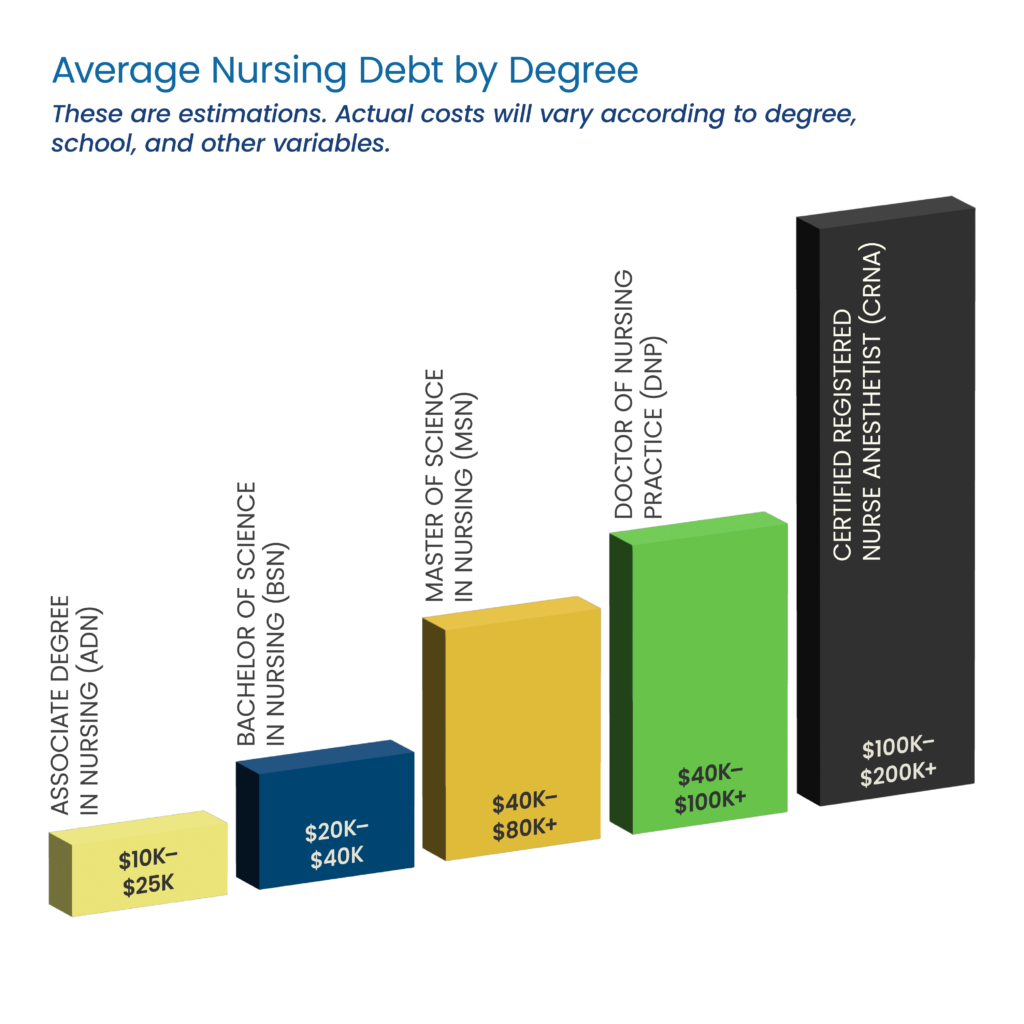
While these ranges provide context, the total balance alone does not determine the best repayment strategy. Income level, career trajectory, and loan type all play a role in shaping the most effective approach.
Why Nurses Have Unique Advantages
Although student loan debt can feel overwhelming, nurses are in a relatively strong position when compared to other professions.
One of the biggest advantages is access to multiple loan forgiveness opportunities. In addition to federal programs like PSLF, nurses may qualify for specialized programs such as the NURSE Corps Loan Repayment Program and state-based programs that support work in underserved areas. In some cases, these programs can cover a significant portion of a borrower’s balance.
Employers can also play a role. Many hospitals and healthcare systems now offer student loan repayment assistance as part of their compensation packages. These benefits may come in the form of direct contributions, sign-on bonuses, or retention offers tied to continued employment.
Finally, nursing offers a level of career flexibility that can directly impact repayment. Working for a nonprofit may open the door to forgiveness, while higher-paying roles, such as travel nursing, can make accelerated repayment more feasible.
Because of these factors, nurses are often able to take a more flexible approach to their student loans.
Federal Repayment Plans: Finding Your Best Fit
For nurses with federal student loans, selecting the right repayment plan is a critical financial decision. Your choice affects not only your monthly payment but also your eligibility for forgiveness programs and the total amount repaid over time.
Standard Repayment vs. Income-Driven Plans
The Standard Repayment Plan is the default option for federal student loan borrowers. It provides a fixed monthly payment over a 10-year term and typically results in the lowest total interest paid. While this approach is straightforward, it does not provide a path to loan forgiveness.
Income-Driven Repayment plans are structured differently. Payments are based on income and family size, which can make them more manageable, particularly for nurses early in their careers. These plans also extend the repayment period and are required for borrowers pursuing programs such as PSLF.
Federal Repayment Plans: Monthly Payment Comparison
| Repayment Plan | How Payments are Calculated | Example Monthly Payment | Best For |
|---|---|---|---|
| Standard | Fixed over 10 years | $212 | Paying off loans quickly |
| IDR (Income-Driven) | Based on income | $180 – $320 | Lower or flexible payments |
Example assumes $20,000 in federal student loans, a 5% fixed interest rate, and $65,000 in annual income. IDR payments vary by plan, household size, and income.
Generally, the Standard Plan is best for borrowers focused on paying down debt quickly, while IDR plans are often used by those seeking flexibility or pursuing forgiveness.
Comparing SAVE, PAYE, IBR, and ICR
It’s important to note that active legal actions may change the following information.
As of March 2026, some income-driven repayment plans, including the Saving on a Valuable Education (SAVE), Pay as you Earn (PAYE), and Income-Contingent Repayment (ICR) plans, are facing modifications or potential phase-outs due to ongoing policy discussions and legal action.
According to recent legal action, these plans are expected to be phased out by 1 July 2028. Borrowers enrolled in these plans could be required to transition to a new repayment plan; guidance from the Department of Education is still forthcoming.
The Income-Based Repayment (IBR) plan is generally expected to remain available to borrowers who take out loans on or before 1 July 2026. However, eligibility requirements and access for future borrowers may change over time.
Although these plans share a similar structure, their differences can affect both monthly affordability and long-term repayment outcomes.
Because of this uncertainty, borrowers should regularly review their repayment plan and stay informed on updates from Federal Student Aid.
Which Plan Aligns with Your Career Stage?
The most appropriate repayment plan often depends on where a nurse is in their career.
Early-career nurses typically benefit from income-driven repayment plans, as lower initial income makes fixed payments more difficult to manage. These plans also preserve eligibility for forgiveness programs.
As income increases, repayment strategy becomes more dependent on individual goals. Nurses working for qualifying employers may choose to remain on an income-driven repayment plan and pursue forgiveness, while others may prioritize paying down their balance more quickly.
Because income and career paths can change over time, it is important to periodically review your repayment plan and adjust as needed. For a broader perspective on building financial stability, check out this helpful article on financial wellness.
Loan Forgiveness Programs Built for Nurses
One of the most significant advantages nurses have is access to loan forgiveness and repayment programs that are not available in other professions. These programs were designed to address healthcare shortages and incentivize work in high-need areas.
Each program comes with specific requirements, timelines, and limitations.
NURSE Corps Loan Repayment Program: Up to 85% Forgiveness
The NURSE Corps Loan Repayment Program is one of the most important forgiveness options available to nurses. It is administered by the Health Resources and Services Administration (HRSA) and is designed to place nurses in areas with critical shortages.
Eligible nurses can receive substantial repayment assistance in exchange for a service commitment at a qualifying facility. The structure is straightforward:
- Up to 60% of eligible education debt is paid in exchange for a two-year service commitment. An additional 25% may be awarded for a third year of service. In total, this can cover up to 85% of qualifying student debt.
- To qualify, nurses must work in a Critical Shortage Facility, which often includes hospitals, clinics, or other healthcare settings in underserved communities. The program is competitive, and not all applicants are selected.
For nurses open to working in high-need areas, this program can significantly reduce debt in a relatively short time.
NURSE Corps Loan Repayment Program Overview
| Eligibility | Service Commitment | Awards |
|---|---|---|
|
|
|
Public Service Loan Forgiveness (PSLF) for Hospital Nurses
Public Service Loan Forgiveness is one of the most well-known federal forgiveness programs, and many nurses may qualify without realizing it.
PSLF is available to borrowers who work full-time for a qualifying employer, such as a nonprofit hospital or government healthcare facility. After making 120 qualifying monthly payments under an eligible repayment plan, the remaining federal loan balance may be forgiven.
For many hospital-based nurses, the key factor is employer eligibility. Most nonprofit hospitals qualify, while for-profit healthcare systems do not.
There are several requirements to keep in mind:
- Payments must be made under a qualifying repayment plan, typically an IDR plan.
- Employment must be certified regularly to track progress toward forgiveness.
- Payments must also be made on time and in full.
PSLF can be a valuable long-term strategy, but it requires consistency and proper documentation. Missing certifications or being on the wrong repayment plan can delay or prevent forgiveness.
For a full breakdown of eligibility requirements, qualifying employers, and how to track your progress, you can review the official PSLF Help Tool on the Federal Student Aid website.
State-Specific Nursing Loan Forgiveness Programs
In addition to federal programs, many states offer their own loan repayment or forgiveness programs. These programs are often designed to address local workforce shortages, particularly in rural or underserved areas.
While details vary by state, many programs have a similar structure. Nurses receive financial assistance toward their debt in exchange for committing to work in a designated shortage area for a set period.
States like California, New York, Texas, and more have established programs that can provide meaningful repayment support. Below are just a few examples:
- California Healthcare Loan Repayment Programs
- New York Nurses Across New York Loan Repayment Program
- Texas Nurse Loan Repayment Assistance Program
- Maine Nursing Education Loan Repayment Program
- New Mexico Health Professional Loan Repayment Program
To find additional state programs, search [STATE] + [Loan Repayment Program].
Because these programs are administered at the state level, the eligibility requirements, award amounts, and application timelines can differ significantly. Research options specific to your state and monitor application deadlines, as many programs have limited funding and competitive selection processes.
Employer-Based Repayment Assistance
Many healthcare employers now offer repayment assistance as part of their overall compensation packages.
Employer-based assistance can take several forms, including direct monthly contributions toward loans, sign-on bonuses allocated to debt repayment, or retention incentives tied to continued employment.
These programs vary by employer. Some may require a multi-year commitment, while others may include repayment caps or tax considerations.
For nurses evaluating job opportunities, student loan assistance is an important factor to consider alongside salary and benefits.
Advanced Practice and Specialty Program Options
For nurses considering career advancement, the loan payoff strategy becomes more complex. Higher earning potential can make repayment easier, but additional education often comes with new debt.
At the same time, certain advanced roles and specialty paths come with their own loan assistance programs. Understanding these options can help offset the cost of further education and inform long-term financial and educational planning.
Nurse Practitioner Loan Assistance
Nurse Practitioners (NPs) may qualify for many of the same forgiveness programs available to registered nurses, as well as additional opportunities tied to advanced practice roles.
Programs such as the NURSE Corps Loan Repayment Program and Public Service Loan Forgiveness remain relevant for NPs working in qualifying settings. Some NPs may also qualify for the National Health Service Corps (NHSC), which offers loan repayment assistance in exchange for working in designated Health Professional Shortage Areas.
In addition, many state-based programs offer targeted incentives for primary care providers, including nurse practitioners serving in underserved communities.
Because NPs typically earn higher salaries than entry-level nurses, repayment strategies may shift over time. Some may choose to continue pursuing forgiveness, particularly if working for a qualifying employer, while others may prioritize faster repayment as income increases.
The key consideration is how additional borrowing for an NP program fits into your overall plan. Higher earning potential can justify the cost, but it should still be evaluated alongside repayment and forgiveness options.
CRNA and Specialty Certification Programs
Advanced specialties, particularly Certified Registered Nurse Anesthetist (CRNA) programs, often come with significantly higher costs.
These programs are among the most expensive in nursing and may require a full-time commitment, limiting the ability to work during enrollment.
While forgiveness programs like PSLF may still apply after graduation, there are fewer programs specifically designed for CRNA students than for general nursing roles. Some states may offer assistance, but these opportunities will be state-specific. Some examples include:
- Alabama Advanced Practice Nursing Loan Repayment Program
- Nebraska Loan Repayment Program (select OB GYN/CRNA)
- North Dakota Healthcare Professional Loan Repayment Program (select Eligible Professions).
The financial tradeoff is typically tied to earning potential. CRNAs and other specialized roles typically command higher salaries, which can make aggressive repayment viable. For nurses considering this, it’s important to weigh a program’s total cost against expected income and available repayment options.
Military Nursing Loan Repayment
Military service offers a unique pathway for nursing loan repayment. The U.S. Army, National Guard, and the Navy all provide programs designed to attract and retain healthcare professionals. Some of these programs may be restricted to active-duty members of the military:
These programs generally offer repayment assistance in exchange for a service commitment. Benefits may include direct payments toward student loans or sign-on bonuses.
However, they come with specific requirements, including service obligations and potential deployment. As a result, they are best suited for individuals who are open to a military career.
Private Student Loans: Different Rules, Different Strategies
Private student loans operate under different rules than federal loans. They do not offer the same protections or access to forgiveness programs, which often makes repayment strategies focused on repayment and flexibility.
Why Private Loans Do Not Qualify for Federal Forgiveness
Private student loans are issued by banks or other private lenders, not the federal government. Because of this, they are not eligible for federal programs like PSLF.
Loan terms are set when you borrow, and options are limited to what the lender allows.
When Refinancing Makes Sense for Nurses
Refinancing is most relevant for private loans or for borrowers who don’t plan to use federal repayment or forgiveness programs.
For nurses with stable income, refinancing may offer a lower, fixed interest rate, better terms, a more predictable payment structure, or the removal of a federal loan from default status.
However, refinancing federal loans into private loans should be approached carefully. Once completed, federal protections, such as income-driven repayment and eligibility for forgiveness, are lost.
Because of this, refinancing is typically considered only after a borrower has clearly ruled out federal program benefits as part of their overall strategy.
Options for Distressed Private Loans
When private student loan payments become difficult to manage, the available options are more limited than with federal loans. That makes early action especially important.
Sometimes, borrowers can negotiate modified payment terms directly with their lender. This can include temporary relief options or adjusted payment schedules.
For loans that are already delinquent or in default, settlement may be possible, depending on the lender and account status. These situations often require a strategic approach, particularly if legal action has been initiated.
Because private lenders operate under their own guidelines, outcomes can vary significantly.
Understanding the difference between delinquency and default is critical, as missed payments can quickly escalate into serious financial consequences. If you’re uncertain, check out this helpful article on our website.
Making Your Strategic Decision: Forgiveness vs. Payoff
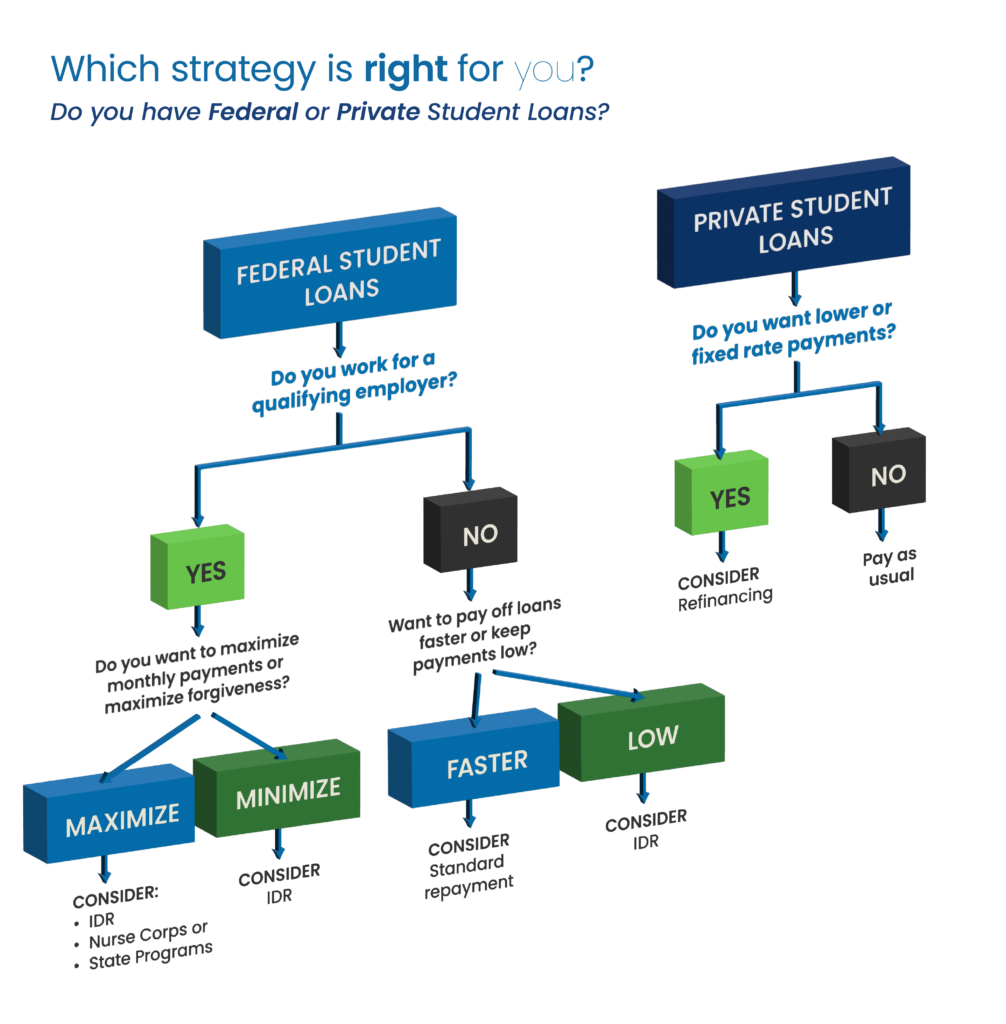
At a high level, most repayment strategies fall into two categories: pursuing loan forgiveness or paying down loans as quickly as possible. The right approach depends on income, loan type, and long-term career plans.
Questions to Guide Your Choice
A few key questions can help narrow the decision:
- Do you have federal loans, private loans, or both?
- Federal loans may qualify for forgiveness, while private loans do not.
- Where do you plan to work? Are you willing to work in underserved areas?
- Working for a nonprofit or government employer may support PSLF eligibility.
- What’s your income trajectory or goal?
- Lower starting income may favor income-driven repayment, while higher income may support faster
- Are you considering advanced degrees?
- Pursuing advanced degrees or changing roles can affect both income and eligibility for programs.
How Career Path Impacts Loan Strategy
Career decisions directly affect repayment strategy. Nurses working in nonprofit hospitals or underserved areas may benefit from structured forgiveness programs.
In contrast, higher-paying roles, such as travel nursing or specialized fields, may make aggressive repayment more practical. Changes in employer, income, or location can all shift the optimal approach over time.
Calculating Your Best Financial Outcome
The most effective strategy is the one that minimizes total cost while remaining manageable month to month.
For some nurses, this means maximizing forgiveness through lower payments over time. For others, it means reducing interest and paying down principal more quickly.
Because outcomes can vary, it is important to periodically review your approach and adjust as your career and financial situation evolve.
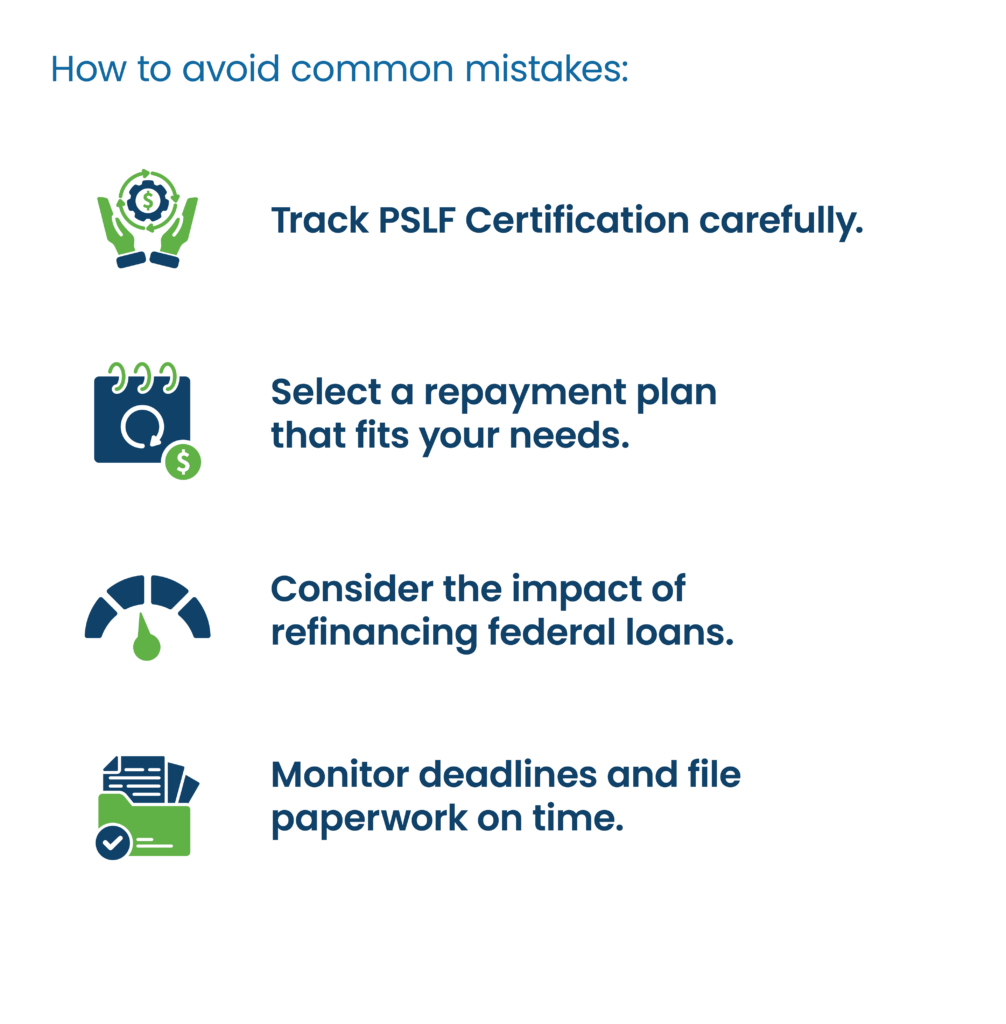
Common Pitfalls and How to Avoid Them
Even with strong repayment and forgiveness options available, small mistakes can limit progress or delay results. Common pitfalls include:
- Not submitting PSLF employment certification regularly: Without proper documentation, qualifying payments may not be counted.
- Choosing the wrong repayment plan: Borrowers pursuing forgiveness need to be on a qualifying income-driven plan. For those not pursuing forgiveness, it’s important to ensure your repayment plan aligns with your financial goals.
- Refinancing federal loans into private loans without careful consideration: Once refinanced, federal protections and forgiveness eligibility are permanently lost.
- Missing application deadlines for programs such as NURSE Corps or state-based repayment options: Many of these programs are competitive and have limited funding.
If you want additional guidance on federal and private repayment strategies, budgeting strategy and more, check out this article on our blog.
Your Action Plan: Next Steps Based on Where You Are
Nursing is a rewarding career, and while student loans are common in the medical profession, there are real options to manage them.
As you move forward, remember to consider your long-term career path, whether it be working in shortage areas or pursuing advanced training, and building a repayment strategy that fits your goals. You’ve got this!
If you have private student loans and don’t meet traditional lender requirements, Yrefy may be able to help. We’ve helped thousands of borrowers with distressed or defaulted private student loans refinance to low, fixed interest rates.
Get in touch with us at (888) 358-3359, or fill out our contact form, and a member of our team will reach out to you.
Disclaimer: This article is for informational purposes only and should not be considered legal or financial advice. Please consult with a qualified financial advisor or attorney regarding your specific student loan situation.