
Private Student Loan Settlements: How They Work & When to Consider Them

What is a Private Student Loan Settlement?
Are you considering a private student loan settlement? If so, there’s a lot to understand before deciding if it’s the right choice for you. Settlements do not have a standard process, and numerous variables (such as negotiations and lump sum payments) are involved. In this guide, we’ll cover some of the most important elements, including alternatives, to help you make an informed decision.
What is a Private Student Loan Settlement?
A private loan settlement is an agreement between a borrower and a private lender (or a collection agency acting on the lender’s behalf) to settle a defaulted loan for less than the full amount owed.
Settlements are typically offered only after a loan has become seriously past due or entered into default. Settlements are not guaranteed, but if they are approved, a settlement usually requires a lump sum payment within a specified timeframe to resolve the debt and end collection activity.
How it Works for Federal vs. Private Loans
There are important differences between private loan settlements and federal settlements. Federal loans are governed by federal law and are owned by the Department of Education, which regulates how federal loans can be settled, if at all. In contrast, private loans are owned by the lender that issued the loan, or the current loan holder, and are governed by that lender’s internal policies. This means settlements with a private lender can vary and are handled at their discretion.
This guide focuses on private loan settlements; however, we do have a guide that covers federal settlements as well. See our blog to learn more.
When Settlement is Typically Possible
In many cases, private lenders may consider settlement only when traditional repayment or collection efforts have proven unsuccessful. The key point to remember here is: private lenders are under no obligation to settle a loan.
Why Private Lenders Settle
Factors such as the age of the debt and a borrower’s documented financial hardship may influence if a lender is willing to negotiate a settlement. From the lender’s perspective, a settlement may be viewed as a practical way to recover a portion of the balance rather than continuing prolonged collection activity or taking further legal action (which can be expensive).
How Private Loan Settlements Work
There are many factors that can impact how a settlement works. Understanding the various actions and terms can help borrowers manage expectations before going through the settlement process.
How Private Lenders May Calculate Offers
When evaluating a potential settlement, lenders typically assess how much of the outstanding balance they believe they can realistically recover. This evaluation may include a review of payment history, accrued interest and fees, prior collection attempts, and the cost of continued collection or legal action.
Each factor will impact any offer a lender may make – this is why there are no published standard or average settlement percentages for private student loans.
Charge-Off Timelines
A charge-off is when a lender considers a debt uncollectible or a loss for internal accounting purposes. This does not relieve the borrower of the legal responsibility to pay, it will change how the lender will manage the loan. Once a loan has been charged off, typically after several months of non-payment, it could be turned over to a lender’s internal collections department, assigned to a third-party collection agency, or sold to a debt buyer. Any of these will likely damage a borrower’s credit.
Lump Sum Expectation
If a lender agrees to settle a loan, they will most likely require a lump sum payment within a short, specified timeframe to settle the balance. This means a borrower must have access to significant upfront available cash if a lender agrees, which could be challenging.
Installment-based settlements are rare and are offered entirely at a lender’s discretion.
Factors Affecting Negotiation
Several factors may influence whether a lender is willing to negotiate and what terms they may offer. These can include:
- Delinquency: Loans that are past due, especially for a lengthy period, may be more likely to be considered for settlement than loans that are only slightly delinquent.
- Default: Loans that have entered default, been charged-off, or placed with a collection agency are more commonly considered for settlement.
- Age of the Debt: Older debts, especially those with a history of unsuccessful collection efforts, may be more likely to receive settlement consideration.
What’s Realistic
Private student loan settlements can be unpredictable. They should not be used or considered as the primary repayment strategy. Settlements are typically pursued as a last resort, and even then, there is no settlement guarantee or that the terms will provide meaningful relief.
Borrowers should approach settlement with realistic expectations, and a clear understanding of the risk.
How to Settle a Student Loan (Step-by-Step)
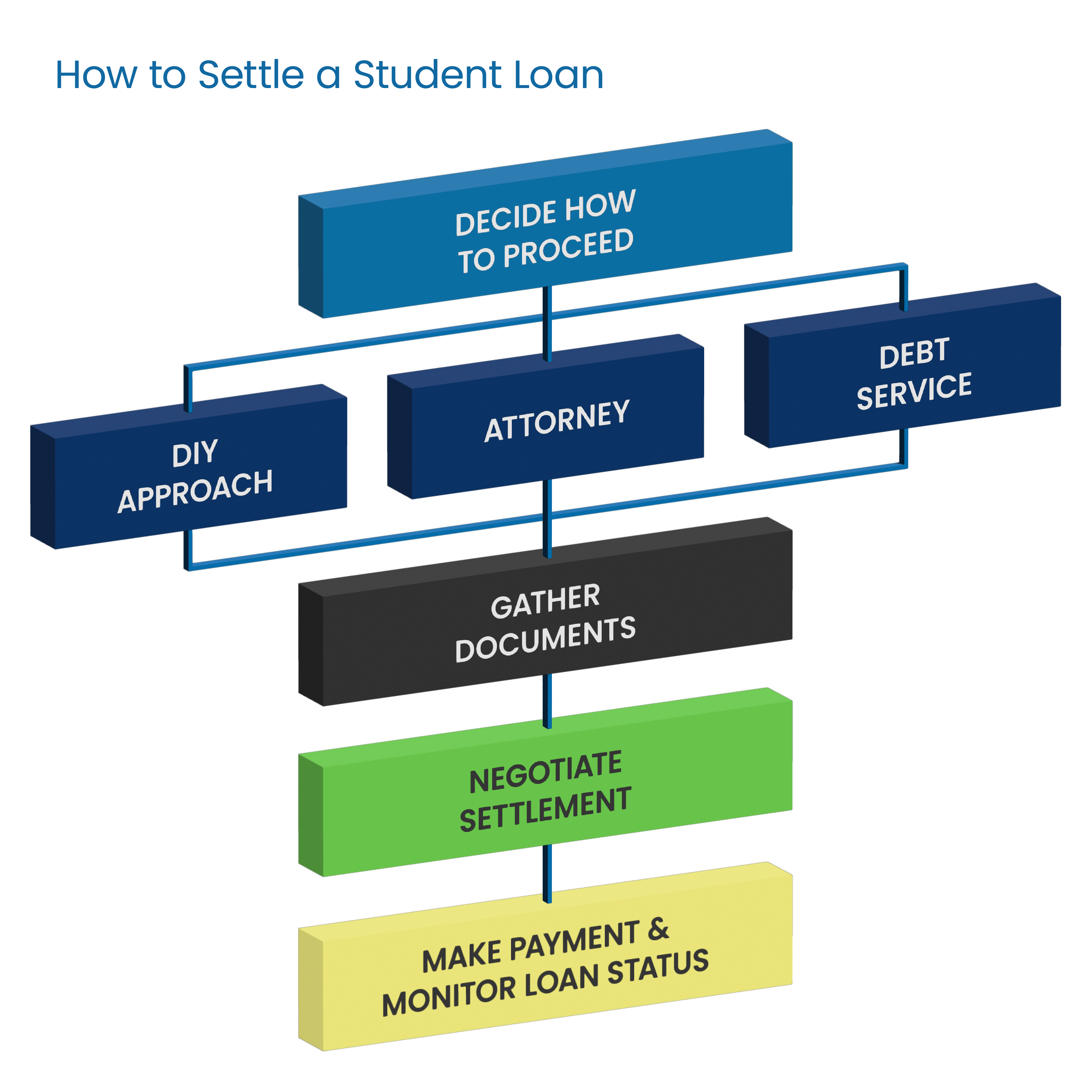
Below is a general overview of the steps a borrower may encounter while pursuing a private loan settlement. Because settlements are NOT a standard process, outcomes and settlement amounts vary. There are three general routes someone has as ways to settle their loans.
Option 1: The DIY Approach
Some borrowers may decide to negotiate a settlement directly with their lender or the collection agency who is representing their lender. This do-it-yourself approach usually involves contacting the lender, discussing reasons for default, and requesting a reduced payoff amount. This will require documentation, negotiation of terms, and ensuring that the agreement is properly recorded before making a lump sum payment. This path is generally cost-effective, as the borrower does the work themselves.
Borrowers considering this DIY approach should do significant research on negotiations and understand all their lender’s policies before moving forward.
Option 2: Using an Attorney
A borrower may choose to hire an attorney to conduct their settlement negotiations. This is often an especially good choice if the situation is complicated or involves legal action. An attorney can help explain legal rights, review settlement terms, and communicate with lenders on the borrower’s behalf. This path may be expensive, as attorneys generally charge fees for these services, and outcomes are not guaranteed.
Option 3: Using a Debt Settlement Service
Some borrowers may choose to work with a debt settlement service. These companies negotiate with a lender on the borrower’s behalf. They typically charge fees for their service. Borrowers considering this path should read extensive reviews and scrutinize a potential candidate’s terms of service before moving forward.
Debt settlement companies cannot guarantee results, as they have no authority over a lender’s decision. In addition, collection activity may continue while negotiations are ongoing, which means interest and fees may accrue during the negotiation period.
What NOT to Do During a Settlement
If possible, borrowers should avoid stopping payments or ceasing communications with a lender during a potential settlement. A lender can terminate negotiations and focus on collection activity instead, which could entail further legal consequences. Borrowers should not agree to verbal agreements without reviewing all terms in writing. They should also not sign any document without carefully reading all the paperwork.
Once a settlement is agreed upon, it’s crucial not to miss any deadline or requested actions by a lender.
How to Avoid Scams
Borrowers should be cautious of companies that promise guaranteed settlement outcomes, request large upfront fees, or claim special access to lenders. Legitimate professionals should be and are usually transparent about costs, risks, and limitations. Borrowers should independently verify all credentials and reviews.
Get Everything in Writing
Before making any payment, borrowers should obtain a written settlement agreement that clearly outlines the amount due, the payment deadline, and how the account will be reported after payment.
Sometimes, credit reports can contain mistakes, and keeping copies of all correspondence and agreements is essential to protect against future disputes.
Pros & Cons of Private Settlements
Settling a private student loan is not a small matter, and it comes with meaningful tradeoffs compared to other alternatives. Understanding the benefits and the risks is crucial before deciding if a settlement is the right approach.
Pros of Student Loan Settlement
One potential benefit of a private loan settlement is closure. Dealing with a loan in default and the associated collection activities and credit impacts can be overwhelming. A settlement can resolve a long-standing debt, end collection efforts (once the agreed-upon lump sum payment is made) and allow a borrower to begin the path toward credit recovery.
In some cases, a settlement may also result in a reduced total balance owed. When a lender agrees to accept less than the full amount due, the borrower may pay less overall than if the loan were repaid in full. However, this may result in tax obligations and credit impacts (read more below).
Cons of Student Loan Settlement
While a settlement can bring an end to a long-standing debt, the negative impacts that come with it may stick around for a while.
- Credit Impacts: A settlement usually occurs after a loan has been in default for a period of time, and the account may be reported as having settled for less than the full balance. This may negatively impact a borrower’s credit report for several years, depending on applicable state and federal laws.
- Cash: Most private settlements require a lump sum payment, which may be difficult or impossible for borrowers who are already under financial strain.
- Taxes: In some cases, forgiven debt can be treated as taxable income, potentially creating an unexpected tax obligation. Borrowers should consult a qualified tax professional before finalizing any settlement.
Finally, borrowers should always be aware of the risk of scams and high-fee services. Not all companies that promise to help are reputable. Guarantees of specific outcomes or requests for large upfront fees can be warning signs of a scam.
Private Student Loan Settlement Alternatives
Borrowers considering a settlement should explore other alternatives that may be easier to obtain and carry less risk to credit history and taxes.
Many lenders (including Yrefy) specialize in refinancing defaulted or private student loans for eligible borrowers. Some lenders also offer modified repayment plans to help a borrower remove a loan from default and get back on track with repayment.
Occasionally, lenders may also have their own hardship programs, which may allow a borrower to either pause or skip payments until their financial situation improves. Private loan hardship programs are not as common as those offered for federal loans, and borrowers should confirm with their lender what programs, if any, are available.
Alternatives to Settlement: Pros & Cons
| Option | Pros | Cons |
|---|---|---|
| Refinancing |
|
|
| Modified Repayment Plan |
|
|
| Lender Hardship Program |
|
|
Settlement vs Refinancing: Which Is Better?
When deciding how to best manage a defaulted private loan, both settlement and refinancing options will inevitably arise.
When Settlement is Appropriate
A private loan settlement may be appropriate if a borrower is unable to repay a loan, has exhausted all other repayment options, and has sufficient cash reserves to offer a lender a lump sum payment. While settlements can resolve a private loan, they also can come with negative credit impacts, tax consequences, and significant upfront cash requirements.
When Refinancing Saves More
Refinancing is the process of replacing an existing loan with a new loan provided by a different lender. The new lender may offer a lower or fixed-interest rate, more favorable terms, or a new repayment plan. This process can save money over the life of the loan by reducing monthly payments and total interest costs. It can also help borrowers avoid defaulting on a loan while minimizing the negative credit impacts and tax consequences that are often associated with settlement. Refinancing with a new lender may entail meeting certain qualifications, such as a credit score, income, or potentially a co-signer.
Yrefy’s role — We Refinance, We Don’t Settle
Yrefy does not offer loan settlement or debt relief negotiation services. Instead, Yrefy specializes in helping eligible borrowers with defaulted or delinquent private student loans by providing fixed-interest rates, personalized repayment plans, and, in some cases, co-borrower release.
As part of the refinancing process, Yrefy may pay off a borrower’s prior loan(s) in a lump sum that is accepted by the previous lender at a discounted amount; however, this is not a negotiated settlement service, and Yrefy does not control how prior lenders report the loan’s final status.
Refinancing Improves Credit . . . Settlement Damages Credit
Refinancing can help rebuild credit over time by establishing a new loan in good standing (no default status). In contrast, a settlement generally has a negative impact on credit, as it signals that the borrower did not repay the original debt in full.
For borrowers seeking to improve financial stability and credit health, refinancing is often the safer, more sustainable path.
Frequently Asked Questions
Got questions? Below are some of the most common questions borrowers ask about private loan settlement.
- What is the typical settlement amount? A private loan settlement is a negotiated process and can vary based on a borrower’s financial history, the lender’s policies and other factors such as the age of the debt. As such, each settlement is highly individualized and there is no standard or guaranteed settlement amount.
- Can I settle private loans through a debt relief company? Private student loans can be negotiated and potentially settled by a debt relief company, but there are risks that borrowers should be aware of. A debt relief company has no authority over a lender and cannot guarantee anything. Additionally, negotiations between a debt relief company and a lender do not stop collection activity, fees, or credit damage. Some debt relief companies may also charge a fee to facilitate negotiations, which may not be feasible for borrowers who are already struggling to repay their loans. It’s important to note that borrowers can negotiate on their own without a debt relief company.
- How much is usually forgiven? Any forgiveness is determined by the lender and depends on the portion of the remaining balance the lender is willing to accept to settle the debt. A lender does not have to accept a settlement at all, and any amount of forgiveness should not be assumed in advance.
- Is settlement right for me? A loan settlement may be an option for borrowers who have exhausted other methods of removing their loan from default and have the ability to make a lump sum payment. Because loan settlements can harm credit scores and result in potential tax obligations, other alternatives should be considered before deciding whether to move forward.
- What is the 7/7/7 or 7-in-7 rule for debt collectors? This rule limits how often third-party debt collectors can contact a consumer. In general, it limits collectors from making more than seven contact attempts within seven consecutive days using the same communication method (such as phone calls). If a collector makes contact, they must wait at least 7 days before contacting the consumer again. However, if a consumer consents to more contact, such as by saying “please try again tomorrow,” the limit resets. Certain states may have further restrictions on debt collector communications.
Final Considerations
Private student loan settlement can offer relief, but other methods such as refinance, repayment plans or potential lender hardship programs should be considered first. Settlement is not a standard process, and it should only be pursued after thoughtful planning and with full awareness of the risks to your credit score, potential tax obligations and cash requirements. Further, you should have a complete understanding of a lender’s policies before moving forward with discussions or negotiations.
While Yrefy does not offer loan settlement services, if you’re struggling with defaulted private student loans, Yrefy is here to help.
Yrefy specializes in working with struggling borrowers who have delinquent or defaulted private student loans, including those with bad credit. Eligible borrowers can receive fixed-rate refinancing, custom repayment plans and, in some cases, co-borrower release.
Want to speak with our team and explore your options? Apply online or call us at (888) 358-3359.
Disclaimer: This article is for informational purposes only and should not be considered legal advice. Always consult with a qualified attorney or financial professional regarding your specific situation.