
Student Loan Options for Teachers: Forgiveness, Repayment Plans, and When Refinancing Makes Sense

Table of Contents
Why Student Loans Are Especially Challenging for Teachers
Teaching is admirable work, but as most teachers know, there are financial trade-offs that come with the opportunity to shape young minds.
Many teachers enter the profession with student loan debt disproportionate to their earnings, which can make repayment seem daunting. Entry-level teaching salaries often lag those of other professions that also require advanced degrees. For those working in underfunded school districts and/or high-cost-of-living areas, the gap between salary and expenses can be even more overwhelming.
However, unlike many professions, teachers also have access to particular student loan forgiveness and repayment programs that can provide meaningful financial relief. These programs exist not only at the federal level but also at the state level.
Let’s study up on some student loan repayment options for teachers and see which plans or programs might offer you a viable path towards financial freedom.
Federal Student Loan Forgiveness Programs for Teachers
It’s important to note that there is a difference between federal student loans and private student loans. Yrefy has covered the difference (and much more) on our blog.
Federal student loans come with distinct federal protections, requirements, and repayment plans. In contrast, private student loans may come with their own protections, requirements, and repayment plans, all of which vary by lender.
For teachers with federal student loans, several programs are available to support educators working in the public sector. While these programs can have similar names, each is distinct and has its own eligibility requirements (which are subject to change).
Teacher Loan Forgiveness (TLF) Program
The Teacher Loan Forgiveness Program offers eligible individuals up to $17,500 in forgiveness for qualifying federal loans. Depending on the subject taught, some may only qualify for a maximum forgiveness amount of up to $5,000.
To qualify, a teacher must:
- Teach full-time for five consecutive academic years.
- Work in a low-income school or educational service agency.
- Hold at least a bachelor’s degree and full state certification.
It is important to note that the TLF program has additional qualifications and requirements. The $17,500 forgiveness amount is limited to highly qualified math, science, and special education teachers.
An important limitation to note is that time spent qualifying for TLF does not count toward Public Service Loan Forgiveness. For some teachers, choosing one program may mean missing out on progress toward the other.
To review the full requirements, please review the TLF page on studentaid.gov.
Public Service Loan Forgiveness (PSLF)
While Public Service Loan Forgiveness is one of the most discussed student loan relief options for teachers, it’s also one of the most detail-driven. The program may forgive the remaining balance on eligible federal Direct Loans after a borrower meets all qualifying requirements, including:
- Working full-time for a U.S. federal, state, local, or tribal government, or a qualifying not-for-profit organization (including public school employment).
- Making 120 qualifying monthly payments under a qualifying repayment plan, such as an Income-Driven Repayment plan (payments do not need to be consecutive).
For teachers who remain in public education long-term and maintain accurate records, PSLF can provide substantial forgiveness. However, the program requires a ten-year commitment, consistent compliance, and periodic submission of the PSLF form to certify qualifying employment. Administrative errors and employment changes can delay or derail progress if not managed carefully.
To review the full list of requirements, please review the PSLF page on studentaid.gov.
Perkins Loan Cancellation for Teachers
Teachers who hold Federal Perkins Loans may qualify for partial or full loan cancellation based on their years of qualifying service. For eligible teachers, cancellation can occur gradually, with a portion of the loan forgiven for each year of qualifying employment.
Eligible benefits may include:
- Up to 100% cancellation over five years for qualifying teaching service.
- Deferment of payments while performing teaching service that qualifies for cancellation.
- Loan discharge under certain circumstances, such as school closure, bankruptcy, or total and permanent disability.
Although the Perkins Loan Program stopped issuing new loans after September 2017, teachers who still hold Perkins Loans should review their eligibility for cancellation before deciding to consolidate or refinance. Once these loans are consolidated or refinanced, cancellation benefits are permanently lost.
To review the full requirements, please review the Federal Perkins Loan page on studentaid.gov.
TEACH Grant Program
The TEACH Grant Program provides grants to current teaching students who are completing or plan to complete coursework needed to begin a career in teaching.
To receive a TEACH grant, you must:
- Serve as a full-time teacher for 4 years at an elementary/secondary school, or another educational service agency that works with low-income students.
- Teach in a high-need field like math, science, reading, special education, or a foreign language (you can visit https://tsa.ed.gov/#/reports to see a full list of teacher shortage areas for your state).
- Complete the required 4 years of teaching within 8 years after graduating from, or ceasing enrollment at, the institution of higher education where you received your TEACH Grant(s).
It’s critical to note that if service requirements are not met, the grant will convert to a Direct Unsubsidized Loan with any accrued interest applied. This conversion can significantly increase repayment costs.
Individuals considering or holding TEACH Grants should track service requirements and provide all the necessary documentation to avoid unintended loan conversion.
To review the full requirements, please review the TEACH Grant Eligibility page on studentaid.gov.
Student Loan Options for Teachers: At a Glance
| What It Does | Best For | Key Think to Know | |
|---|---|---|---|
| Teacher Loan Forgiveness (TLF) | Forgives up to a portion of certain federal loans after 5 years of qualifying teaching. | Teachers in qualifying low-income schools | Does not count towards PSLF |
| Public Service Loan Forgiveness (PSLF) | May forgive the remaining balance on eligible Federal Direct Loans after 120 qualifying payments | Teachers planning long-term public service | Requires ongoing certification and documentation |
| Income-Driven Repayment (IDR) | Sets monthly payments based on income and family size | Teachers needing income-based payment flexibility | Forgiveness, if received, may take 20-25 years |
| Employer Assistance Program (EAP) | Allows employers to contribute toward student loan payments | Teachers whose employers offer the benefit | Availability and terms vary by employer |
| State Programs | Provides loan forgiveness or repayment assistance in certain states | Teachers meeting state-specific criteria | Program rules and funding vary by state |
| Refinancing | May lower interest rates or monthly payments through new loan terms | Teachers focused on repayment rather than forgiveness | Federal benefits are permanently lost if federal loans are refinanced |
Income-Driven Repayment Plans for Teachers
Income-Driven Repayment Plans, often called IDR plans, base monthly payments on income and family size rather than loan balance.
Common IDR plans include:
- Income-Based Repayment (IBR): Caps payments based on income, with forgiveness after 20 or 25 years.
- Repayment Assistance Plan (RAP): A new federal income-driven repayment plan scheduled for release in July of 2026. More details are anticipated to be released by the Department of Education.
The following plans will sunset in July of 2028, but may still be available for enrollment for eligible borrowers. In the future, borrowers enrolled in these IDR plans may be forced to select a new plan, or may be automatically enrolled in RAP.
- Revised Pay As You Earn (REPAYE)
- Pay As You Earn (PAYE)
- Income-Contingent Repayment (ICR)
For eligible teachers, IDR plans can provide significant payment relief and are often required for PSLF eligibility. Monthly payments may be significantly lower than standard repayment amounts; however, lower payments can mean slower principal reduction.
For borrowers not pursuing PSLF, any remaining balance forgiven after 20 or 25 years under IDR may be taxable under current law.
To review the full requirements, please review the IDR page on studentaid.gov.
Employer Student Loan Assistance (Now a Permanent Benefit)
In addition to federal forgiveness and repayment plans, some teachers may have access to employer-sponsored assistance.
Under current federal law, employer student loan assistance is no longer a temporary, pandemic-era program. It is now a permanently available government-sanctioned program. This means employers can now contribute up to $5,250 per year towards their employees’ qualifying student loan payments. When offered through a formal Education Assistance Program (EAP), those contributions are available tax-free to the employee.
The availability of this assistance depends entirely on whether an employer has adopted the benefit and on how the program is structured. Not all employers participate, and eligibility rules can vary. Teachers interested in this option should check with their HR department, benefits administrators, or union representatives to see if this assistance is offered and how it works alongside other repayment or forgiveness programs.
While employer assistance may not fully repay loans on its own, it can be a valuable supplement that helps reduce balances faster and ease monthly financial pressure.
State-Sponsored Student Loan Assistance Programs
Many states offer student loan assistance programs for teachers, particularly those working in high-need locations or specific subjects which may vary by state (e.g., math, science, or special education).
These programs vary by state and may include:
- Direct repayment assistance.
- Grants tied to service commitments.
- Loan forgiveness for specific roles or regions.
Teachers may find state-based programs through state education departments, or official state financial aid websites. To find these, try searching “STATE NAME + Teacher Loan Forgiveness Programs”. Please see some examples of state-specific programs below:
- Arizona Teacher Loan Forgiveness
- California Teacher Loan Forgiveness
- Colorado Teacher Loan Forgiveness
- Nevada Teacher Loan Forgiveness
Because funding and eligibility rules change, it is important to verify current details before relying on these programs.
Pros and Cons of Student Loan Forgiveness for Teachers
Federal or state loan forgiveness can be a major financial win for teachers who qualify and complete the requirements. However, forgiveness is not a one-size-fits-all solution, and it comes with trade-offs that should be carefully weighed before committing.
Pros and Cons
The pros may include:
- Potentially substantial loan balance reduction.
- Alignment between public service and financial goals.
The cons may include:
- Long-term commitments, often ten years or more.
- Administrative complexity and documentation requirements.
- Limited career flexibility if employment or career goals change.
- The possibility that program rules or eligibility requirements could change over time due to federal or state policy shifts.
Consider: for some teachers, the emotional weight of waiting years for forgiveness and consistently managing paperwork and certifications can be just as challenging as the financial burden itself.
When Refinancing May Make Sense for Teachers
While refinancing is a powerful and common financial tool, it is not a forgiveness program, and it is certainly not right for every individual teacher.
Refinancing may make sense when:
- Student loans are private and not eligible for federal forgiveness.
- Federal forgiveness programs are unlikely to apply due to a specific career path.
- Interest rates are high, and repayment is the primary goal.
- Financial stability allows for consistent payments.
Refinancing federal loans converts them into private loans, which permanently removes access to federal benefits, including forgiveness and income-driven repayment plans. The Department of Education does not currently offer refinancing for its loans. Because of this, federal loans can only be refinanced through a private lender.
This is why refinancing is generally the most appropriate option for teachers with private student loans or who have carefully evaluated and ruled out federal options.
Before refinancing, teachers should consider:
- Job stability and income levels.
- Long-term career plans.
- Existing loan types and their benefits.
Choosing the Right Path for Your Life and Career
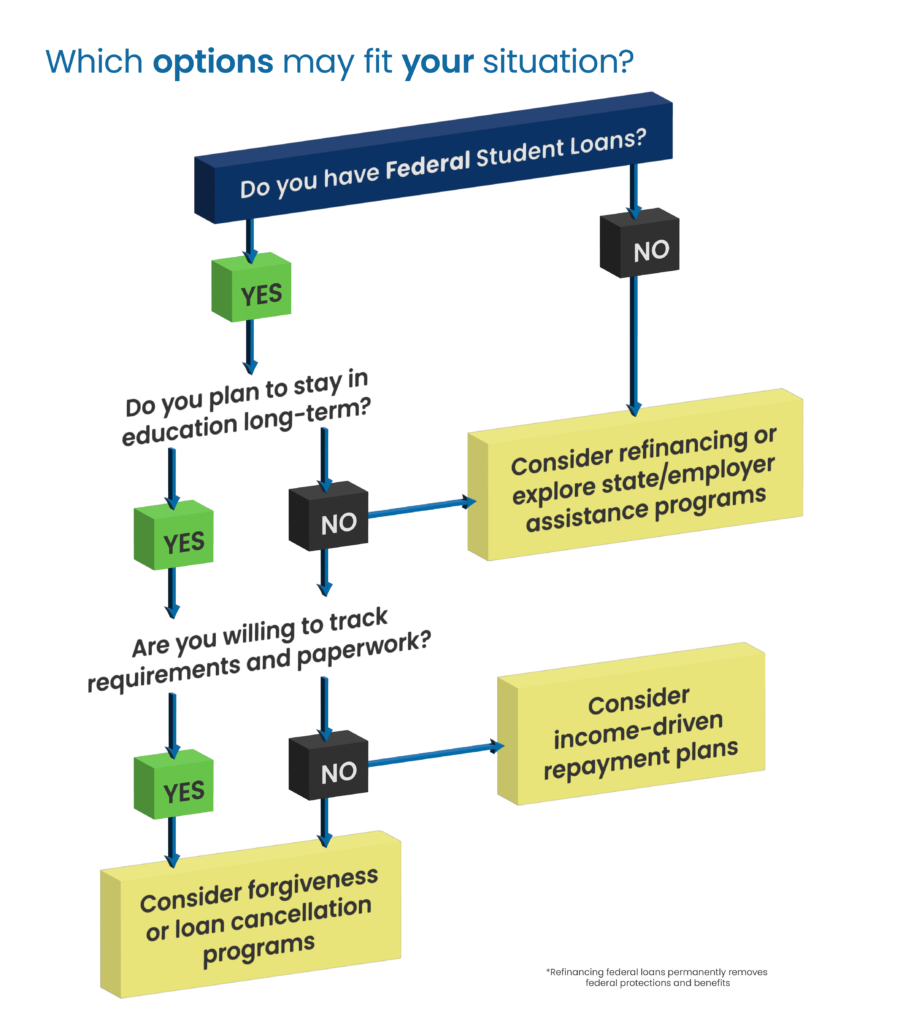
There is no single best loan strategy for all teachers and aspiring teachers. The right choice will vary by each person’s goals, financial situation, and individual priorities. By asking yourself a few simple questions, the right option may become clearer.
Questions to ask yourself include:
- Do I plan to stay in public education long-term?
- Am I prepared to actively track forgiveness requirements and manage paperwork?
- How comfortable am I with a long forgiveness timeline?
- Are my loans federal, private, or a mix?
Taking time to evaluate these questions can help avoid costly missteps and align your repayment strategy with the life you are building.
Forgiveness vs Repayment vs Refinancing
| Forgiveness | Income-Driven Repayment | Refinancing | |
|---|---|---|---|
| Purpose | Reduce or eliminate the loan balance after service | Lower monthly payments based on income | Lower interest rate or monthly payment |
| Eligible Loans | Federal only | Federal only | Federal or private |
| Key Trade-Off | Strict rules and documentation | Slower payoff, possible tax impact | Loss of federal protections |
| Best For | Teachers committed to long-term public service and compliance | Teachers prioritizing relief and flexibility | Teachers with stable income who want to reduce interest and repay faster |
Final Thoughts + Next Steps
Teachers deserve our admiration, and they deserve clear, accurate information when making student loan decisions.
Forgiveness programs, income-driven repayment plans, employer assistance, and refinancing each serve different purposes. It can be a lot to consider, but it’s critical to review all options carefully before committing to any single program or plan.
If you are a teacher with private student loans, and forgiveness programs don’t apply to your situation, learning about refinancing options may be a helpful next step. Yrefy is here to help.
Yrefy is not a traditional lender. We consider more than just your salary or your credit score when determining eligibility. We specialize in refinancing defaulted or delinquent private student loans, helping borrowers lower their monthly payments and save thousands. We have the testimonials to prove it.
Get in touch with us at (888) 358-3359, or fill out our contact form, and a member of our team will reach out to you.
This article is for informational purposes only and should not be considered legal or financial advice.