

The Complete Guide: Student Loan Wage Garnishment

Table of Contents
What You Need to Know About Student Loan Wage Garnishment
Wage garnishment is one of the most stressful consequences of defaulting on student loans. When money is taken from your paycheck, it can feel both frightening and personal.
It’s important to understand that wage garnishment for student loan debt is serious but not permanent, and it is often both preventable and stoppable.
If you’ve just received a notice, are already seeing garnishments in your paycheck, or think you’re heading toward default, this guide will walk you through some common options for what to do next.
If you’re overwhelmed, that’s understandable. Take a moment to breathe, and let’s review the basics.
What is Student Loan Wage Garnishment? The Process Explained
Wage garnishment happens when a portion of your disposable income is withheld from each paycheck and sent directly to your loan holder.
Disposable income refers to your earnings after legally required deductions are made, like federal and state taxes, Social Security, and Medicare.
Depending on your loan type (federal or private), wage garnishment is applied differently. Additionally, both federal and state laws impact the percentage of available wages that can be garnished. Generally, the federal government can garnish up to 15% of a borrower’s disposable income, subject to federal limits. While private creditors may garnish up to 25%, subject to state limits.
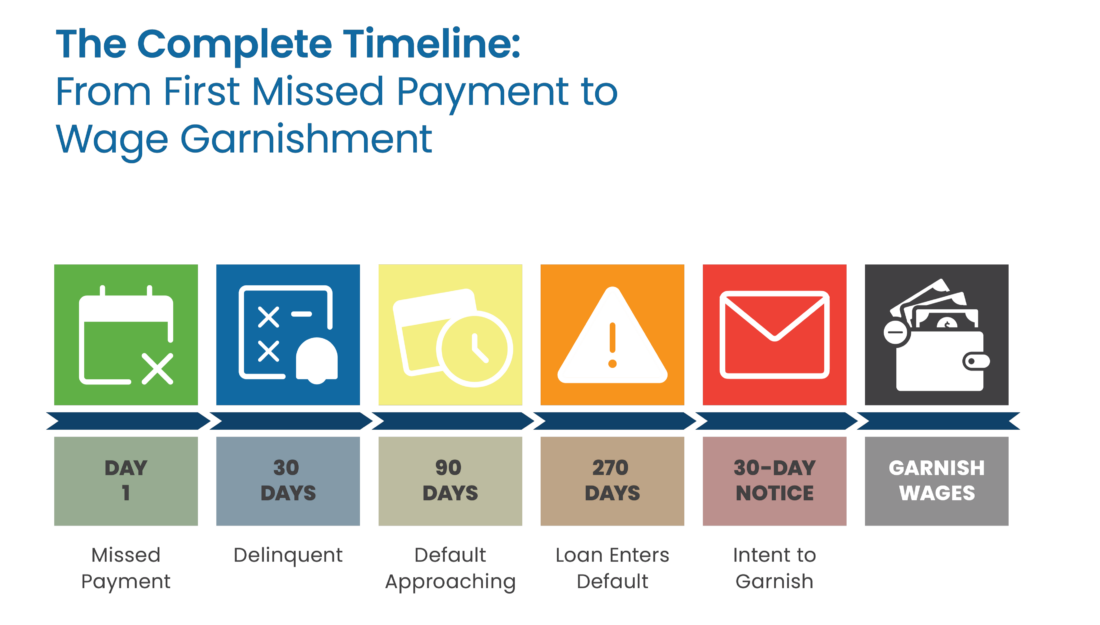
The garnishment timeline differs for federal and private student loans.
Below is a general timeline for federal loans; private student loan garnishment is difficult to generalize due to the required legal action (explained later). For now, just note that garnishment timelines can change depending on applicable laws and the terms and conditions of the loan.
Federal Student Loan Garnishment Timeline:
- Day 1: A payment is missed
- 30-90 days: Loan becomes delinquent
- Up to 270 days: Continued delinquency
- At 270 days: Loan enters default
- Post-default: Collections activity begins
- 30-day written notice: Intent to garnish
- Garnishment begins
Federal Student Loans: Administrative Wage Garnishment
Federal student loan wage garnishment operates under the Administrative Wage Garnishment (AWG) process. Unlike with most types of consumer debt, the federal government and its collection representatives don’t need to sue a borrower in court before garnishing their wages. No court order is required for the government to act.
How Administrative Wage Garnishment Works
Once a federal loan enters default (typically after 270 days of nonpayment), the Department of Education or its contracted collection agency may initiate administrative wage garnishment.
If the borrower takes no action during the default window, their employer will be instructed to begin withholding wages. Prior to garnishment a borrower must receive:
- A written notice at least 30 days before garnishment begins.
- An explanation of borrower rights.
- Information about how to request a hearing.
- Protection from being fired after a single garnishment.
Federal law states that an employer cannot terminate an employee because of a single wage garnishment order. However, multiple garnishments may be treated differently depending on individual state law.
How Much Can Federal Student Loans Garnish From Wages?
Federal law allows garnishment of up to 15% of disposable income, subject to federal limits. However, a borrower must be left with at least 30 times the federal minimum wage per week (based on current minimum wage calculations). For most full-time workers, the 15% cap applies.
In addition to wage garnishment, defaulted federal loans may also trigger:
- Federal tax refund offsets
- Social Security benefit offsets
While these are separate mechanisms from wage garnishment, they are often associated with default.
Private Student Loans: Court Judgments Required
Private student loan wage garnishment is a different legal process from federal loan garnishment.
Private lenders do not have the authority to issue administrative wage garnishments. Rather, they must:
- File a lawsuit against a borrower.
- Obtain a court judgment.
- Secure a wage garnishment order.
- Serve that order to the borrower’s employer.
This process can take months, depending on court timelines and a borrower’s response to the lawsuit.
How Much Can Private Student Loan Lenders Garnish?
In many states, federal law permits private creditors to take up to 25% of disposable income. However, some states restrict wage garnishment, or in some cases, prohibit it for most consumer debt (with exceptions such as federal loans, taxes, or child support). Certain states, like Texas, Pennsylvania, North Carolina, and South Carolina, significantly restrict wage garnishment for many consumer debts, though exceptions may apply.
Why is this important?
Borrowers researching private student loan garnishment should focus their search on the state where they reside, as state law plays a major role.
For example, a borrower seeking state-specific laws might search: “can my private student loans be garnished in [STATE].”
Regardless of whether a state restricts garnishment, if you are sued, it is important to seek legal counsel to determine how to respond. Failing to respond can come with serious consequences, including a default judgment.
What Happens to Your Paycheck?
Wage garnishment for private or federal student loans can greatly impact take-home pay.
Let’s look at an example and assume:
- Gross monthly income: $4,000
- Disposable Income (after mandatory deductions): $3,200
- Garnishment at 15%: $480 per month
- The final monthly take-home pay in this example would decrease from $3,200 to $2,720.
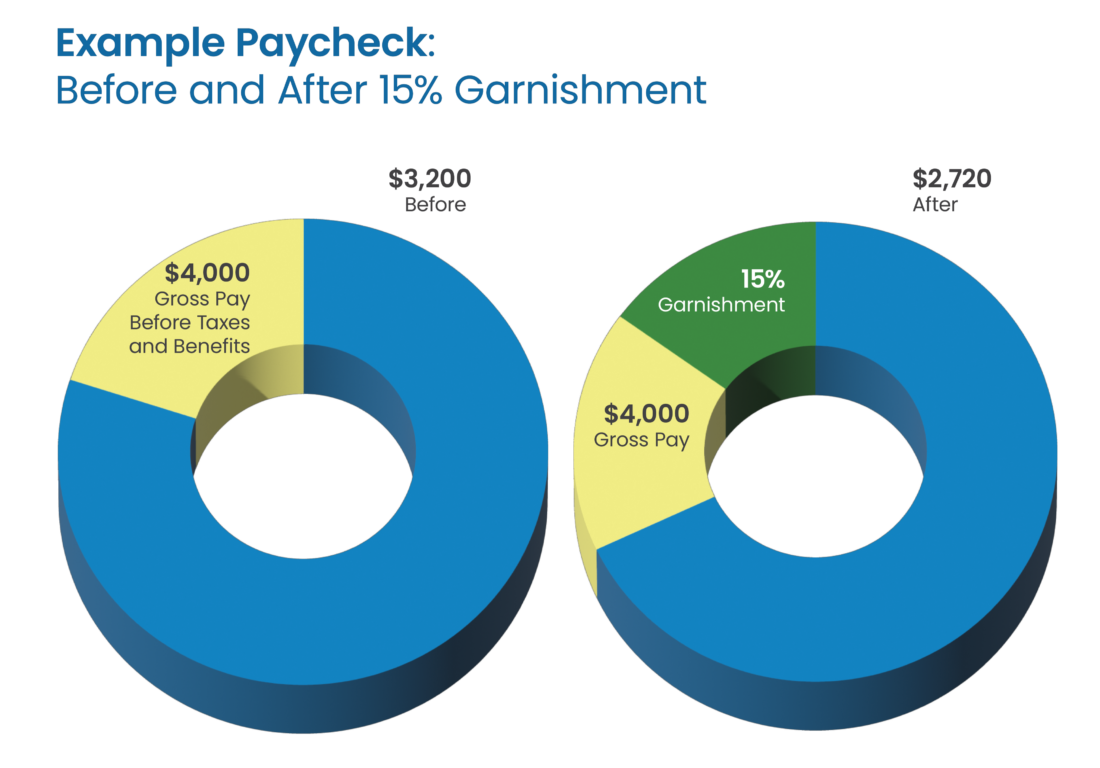
For many individuals, that reduction significantly affects their ability to pay for rent, utilities, food, and other essentials.
Will My Employer Know?
Because payroll or HR must process a garnishment order, they will know.
However, an employer is legally prohibited from terminating someone because of a single garnishment. Most employers treat wage garnishments as a confidential payroll matter and limit internal disclosure to those who need to process them.
Will It Impact My Credit?
By the time a wage garnishment has been pursued or implemented by a court, it has typically already impacted a borrower’s credit.
The garnishment itself doesn’t necessarily show up on a credit report. The damage usually stems from reporting on delinquency, collection activity, and the default itself.
Stopping the default, not just the garnishment, is what can ultimately stabilize credit reporting.
What if I Receive Social Security or Federal Benefits?
If a borrower is not employed or if wage garnishment is not available, defaulted federal student loans may still trigger collection through the Treasury Offset Program (TOP).
TOP allows the federal government to withhold a portion of certain federal payments, including:
- Social Security retirement benefits
- Social Security Disability Insurance (SSDI)
- Federal tax refunds
Under current federal law, up to 15% of Social Security benefits may be offset for defaulted federal student loans, subject to a protected minimum monthly benefit amount.
Borrowers who are permanently disabled may qualify for a Total and Permanent Disability (TPD) discharge, which is a separate process that may eliminate the debt entirely if approved.
For more information, please review the TOP page on treasury.gov.
How to Stop Student Loan Wage Garnishment
If you are currently facing garnishment, it is essential to understand that there are structured options available.
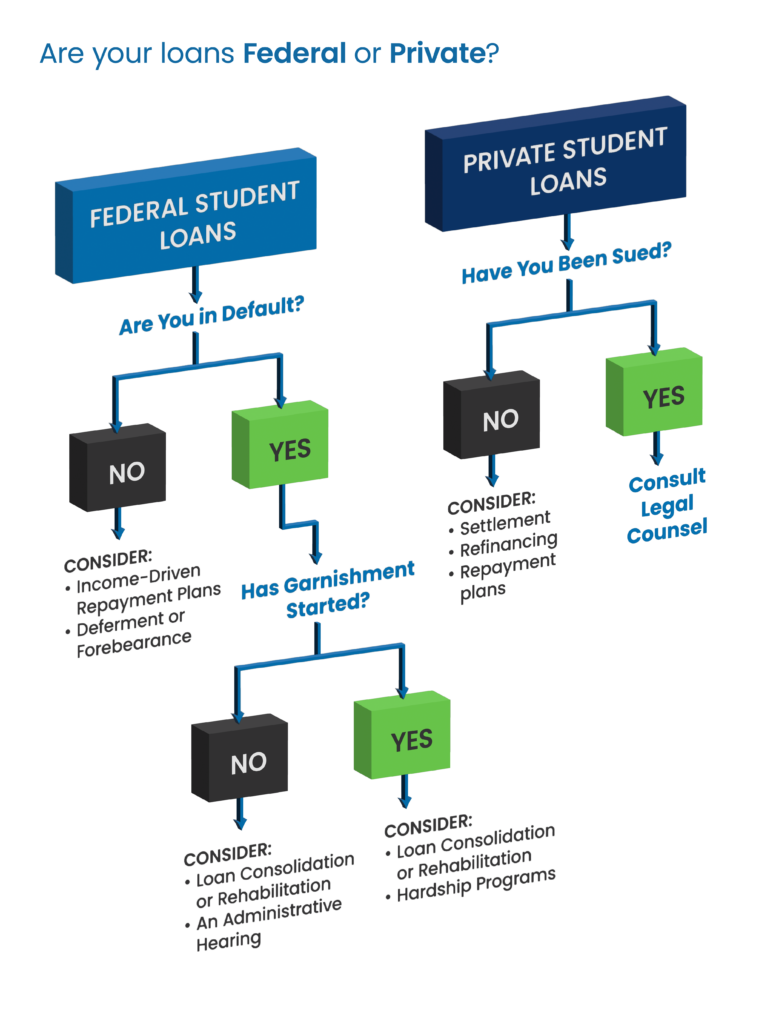
The right path depends on whether your loans are federal or private, if garnishment has already begun, and your overall financial situation.
Below are some of the most common methods for stopping wage garnishment.
Option 1: Loan Rehabilitation (Federal Loans Only)
Loan rehabilitation is a federal program designed to remove a federal student loan from default.
How it works:
- A borrower agrees to make 9 monthly voluntary, on-time payments within 10 months.
- Payments are generally calculated at 15% of discretionary income.
- After completing the full program, the loan is removed from default.
Consider that:
- Rehabilitation can only be used once per loan.
- Garnishment will continue until sufficient qualifying payments are made.
- Late payments leading up to the default may remain on a credit report.
For borrowers with federal loans, rehabilitation is often one of the most structured and predictable ways to stop garnishment.
For more information, review the Student Loan Rehabilitation page on studentaid.gov
Option 2: Direct Consolidation Loan (Federal Loans Only)
Another option for borrowers with federal loans is consolidating one or more defaulted student loans into a new Direct Consolidation Loan.
To qualify, a borrower must typically:
- Apply and meet eligibility requirements.
- Make three voluntary on-time monthly payments; or
- Agree to enroll in an Income-Driven Repayment (IDR) plan.
If consolidation is approved, the new loan pays off the old, defaulted loan. Garnishment generally stops after the consolidated loan pays off the defaulted loan, and the employer receives notice to stop withholding.
Unlike rehabilitation, consolidation does not remove the prior default history from a credit report, but it does resolve the active default status. Processing times can vary, and garnishment may continue until consolidation is finalized.
For full details on eligibility, application steps, and current requirements, borrowers should review the Loan Consolidation page on studentaid.gov.
Option 3: Request an Administrative Hearing (Federal Loans Only)
After receiving a 30-day notice of intent to garnish, borrowers with federal loans have the right to request a hearing with their loan servicer. Hearing requests must be submitted using the contact information provided in the garnishment notice, which is typically managed by the Department of Education or its contracted collection agency.
Possible reasons to contest garnishment include, but are not limited to:
- Financial hardship
- Incorrect loan balance
- Identity theft
- The loan is not legally enforceable
If a hearing is requested within the required timeframe, garnishment may be paused while the hearing is pending.
A hearing is not always a permanent solution, but it can reduce or delay garnishment depending on the outcome.
Federal vs Private Student Loan Wage Garnishment
| Federal Student Loans | Private Student Loans | |
|---|---|---|
| Court Order Required? | No | Yes |
| Max Garnishment Amount | Up to 15% of disposable income (subject to limits) | Up to 25% of disposable income (subject to limits) |
| Notice Period | 30-day written notice | Varies by state / court |
| Timeline | 270+ days to default | Can vary due to lawsuit and judgement process |
Option 4: Negotiate a Settlement or Payment Arrangement (Federal or Private Loans)
In limited circumstances, settlement options may be available — particularly for private student loans. Federal loan settlements are restricted and subject to Department of Education guidelines.
Settlement typically involves:
- A lump sum cash payment for less than the total balance owed; or
- A structured repayment agreement.
Borrowers should be aware:
- Settlement often requires access to cash.
- Forgiven amounts may have tax implications.
- Not all loans qualify for settlement programs.
Settlements are complicated. Yrefy has two blog posts dedicated to both federal settlements and private student loan settlements. Before agreeing to a settlement, it is important to evaluate affordability and confirm all terms in writing.
Option 5: Refinance Out of Default (Primarily Private Loans)
Traditional lenders generally will not refinance student loans that are in default. However, certain lenders (such as Yrefy) specialize in refinancing defaulted private student loans. Depending on eligibility and timing, refinancing may help resolve a garnishment.
If refinancing is approved:
- The new lender will pay off the defaulted loan.
- Once the defaulted loan or judgment is satisfied through refinancing, the creditor may formally release the garnishment order.
Refinancing typically requires:
- Verifiable income
- Stable employment
- In some cases, a cosigner
Refinancing is not right for every borrower, especially for those with federal loans, where borrower protections may be forfeited. However, for private loans in default, it can provide a structured exit from collections and garnishment.
For additional reading, please read the Complete Guide to Student Loan Refinancing on our blog.
How to Prevent Wage Garnishment Before It Starts
If you are delinquent but not yet in default, prevention should be the priority.
Once a loan defaults, your options become limited, and the consequences are often financially severe.
Warning Signs You’re Heading Toward Garnishment
Student loan wage garnishment does not happen overnight. In many cases, there are clear signs before a loan moves into collections.
Warning signs include:
- You are 90 days or more past due.
- The loan has been transferred to a default resolution or collections unit/agency.
- You are receiving increased collection calls or written notices referencing default.
- You receive a formal notice of intent to garnish wages.
Federal loan defaults generally occur after 270 days of nonpayment. This is like a 270-day countdown, and acting before that point offers more options for preventing wage garnishment.
Deferment and Forbearance Options
If your hardship is temporary, deferment or forbearance may help prevent default.
Student loan deferment is a temporary pause in student loan payments for a qualifying reason, such as job loss. Forbearance is a temporary pause or reduction in student loan payments, also for a qualifying reason.
Deferment and forbearance come with eligibility requirements. Not all borrowers or loan types will qualify.
While these are not long-term solutions, deferment and forbearance can create breathing room and help prevent a loan from reaching default, and ultimately, wage garnishment. Talk with your loan servicer to better understand if they offer deferment or forbearance policies.
Special Circumstances and Common Questions
Student loan wage garnishment can become complicated depending on factors such as employment status, state of residence, and income source. These factors may affect how garnishment works administratively, how much can be garnished, or what options remain available to a borrower for responding.
To help address confusion around these special circumstances, we’ve compiled answers to some common questions below.
Can They Garnish My Spouse’s Wages?
It depends.
- In non-community property states: No, unless your spouse co-signed.
- In community property states (like Arizona, California, Idaho, Louisiana, Nevada, New Mexico, Texas, Washington, and Wisconsin), community property laws may, in certain circumstances, allow a creditor to reach community income.
If your spouse did not co-sign and does not live in a community property state, your spouse’s wages are generally protected. However, consider consulting legal and financial experts if this is a concern.
Could I Be Fired for Wage Garnishment?
Federal law prohibits termination because of a single wage garnishment order. Protections for multiple garnishments vary by state.
Your employer will receive a formal garnishment order requiring them to withhold a portion of your wages. While it may feel uncomfortable, employers are typically accustomed to processing garnishments.
If you are concerned about how your employer may respond, consider speaking with your HR department proactively.
What if I’m Self-Employed or Have Irregular Income?
Traditional wage garnishment applies to W-2 wages. If you are self-employed, creditors may pursue alternative collection methods such as bank account levies or liens.
To protect yourself, monitor your accounts closely and respond to any legal or collection notices with the aid of trusted legal or financial counsel. If your income is irregular, proactively consider alternative payment arrangements in advance, such as Income-Driven Repayment plans (for federal loans) or available hardship programs offered by private lenders.
The garnishment risk does not disappear with self-employment, but enforcement mechanisms will change.
Can I Stop Garnishment if I’m on Disability or Social Security?
If you are receiving Social Security or certain disability benefits, creditors typically cannot garnish those payments directly. However, federal loans may still be collected through an offset.
Wage garnishment and benefit offsets are not the same.
Under the Treasury Offset Program, certain federal payments, including Social Security benefits, may be offset to repay defaulted federal student loan debt. Some income types are protected or partially protected and may be subject to limits.
If you rely primarily on disability or Social Security income, it is important to confirm whether you are actually facing a wage garnishment or a federal benefit offset, as the rules and protections differ.
Final Thoughts + Next Steps
Student loan wage garnishment can feel scary, but it follows specific legal procedures and limits. Understanding how the process works is the first step toward resolving it.
If you have delinquent or defaulted private student loans and are dealing with wage garnishment, learning about refinancing options may be a helpful next step. Yrefy is here to help.
Yrefy is not a traditional lender. We consider more than just your credit score when determining eligibility. We’ve helped countless borrowers lower their monthly payments and save thousands. We have the testimonials to prove it.
Get in touch with us at (888) 358-3359, or fill out our contact form, and a member of our team will reach out to you.
Disclaimer: This article provides general information and should not be considered legal advice. For specific legal guidance, consult an attorney licensed in your state.